

The Queensland bottle tree, Brachychiton rupestris, is one of the most recognisable trees in Australia and one of the toughest. Its swollen trunk stores water, which is how it gets through drought. This guide covers where it grows, how big it gets, how to plant and look after it, and how long the bottle shape takes to form.
Introduction to the Australian bottle tree
Brachychiton rupestris is native to the dry inland of central and southern Queensland, where it grows in brigalow and vine scrub on heavy clay and on stony ridges. It belongs to the same genus as the kurrajong and the Illawarra flame tree. In the wild it reaches 10 to 20 metres. In a garden, expect about 8 metres tall and 4 metres wide over many years, with a trunk that can eventually pass a metre across.
Unique characteristics
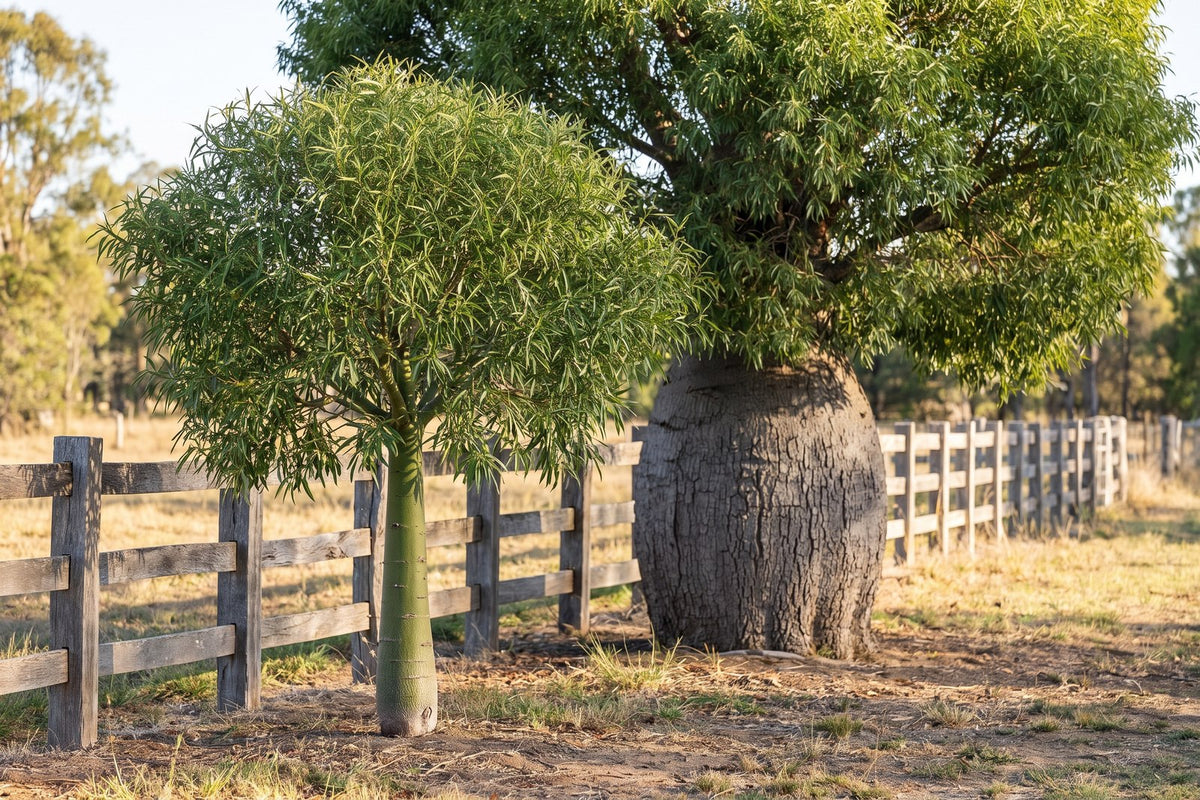
- The trunk. Green and smooth when young, grey and fissured with age. The swelling starts to show at about five to eight years and keeps widening for decades.
- The leaves. Narrow and variable. Young trees often carry deeply divided leaves, and mature trees carry simple, slender ones.
- Leaf drop. The tree sheds some or all of its leaves for a short time in late spring, before flowering, and in very dry spells. This is normal.
- The flowers. Clusters of small cream bells, marked with red inside, from October to December, followed by woody, boat shaped pods. The seeds are surrounded by fine hairs that irritate skin, so handle pods with gloves.
It sits comfortably among the species in our guide to unusual trees that make a garden stand out.
Where it grows in Australia
| Location | How it performs |
|---|---|
| Inland and central Queensland | Home ground |
| Brisbane and south east Queensland | Very good in a well drained position |
| Sydney and coastal NSW | Good; drainage matters in wet summers |
| Melbourne, Adelaide, Canberra | Good, though slower. Mature trees take frost; protect young trees for the first few winters |
| Perth | Very good in sandy soil |
| Tropical coast | Grows where the soil drains freely through the wet season |
If water restrictions shape your planting, our list of drought tolerant plants for Brisbane gardens pairs well with it.
Growth and lifespan
Bottle trees are slow. A young tree in good conditions puts on perhaps 30 to 50 cm a year, and the trunk thickens faster with summer water and feeding. They are very long lived, with planted avenues more than a century old still standing in Queensland towns. For what counts as a mature tree and how long that takes, see our guide to tree maturity. If you want the shape from the first day, buy the largest tree the budget allows: bottle trees transplant well at any size.
Ideal growing conditions
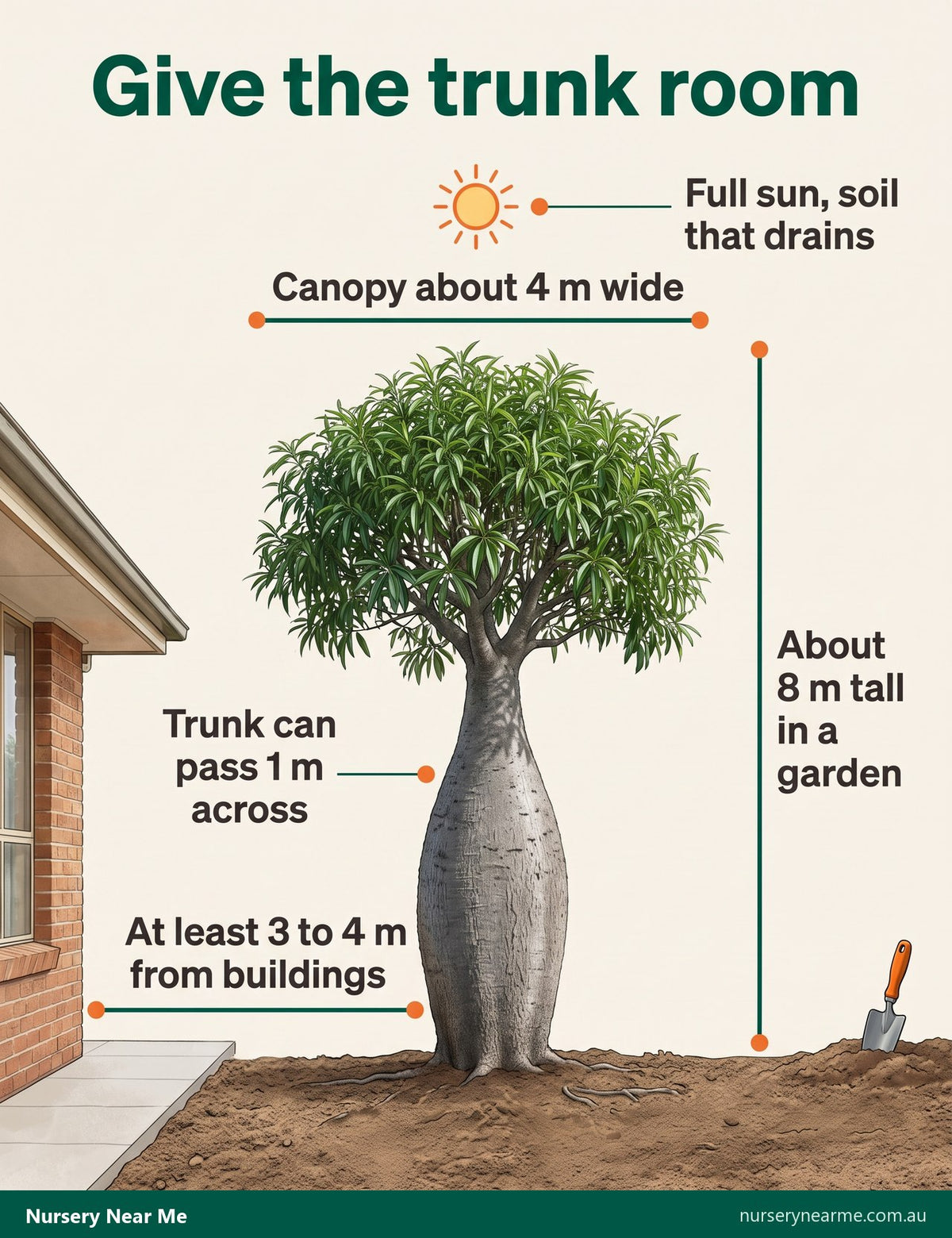
- Sun. Full sun.
- Soil. Any soil that drains, from sand to clay loam. Wet feet are the one thing it will not take.
- Space. Allow for the trunk as well as the canopy. Plant at least 3 to 4 metres from buildings, walls and paving.
If there is a sewer or stormwater line anywhere near the planting spot, our planting near pipes guide gathers the water utilities' distances and their lists of trees to avoid.
Caring for your bottle tree
- Planting. Plant at the same depth as in the pot, in a hole twice as wide. On heavy clay, plant on a mound.
- Watering. Water weekly through the first summer and fortnightly through the second. After that, an established tree lives on rainfall in most of Australia. Deep watering in dry summers speeds the growth of the trunk.
- Feeding. A slow release fertiliser for native plants in spring is enough.
- Pruning. Little is needed. Remove dead or crossing branches, and lift the lower branches as the tree grows if you want the trunk on show.
- Staking. Stake only if the site is windy, and remove the stake after a year.
Bottle trees in pots
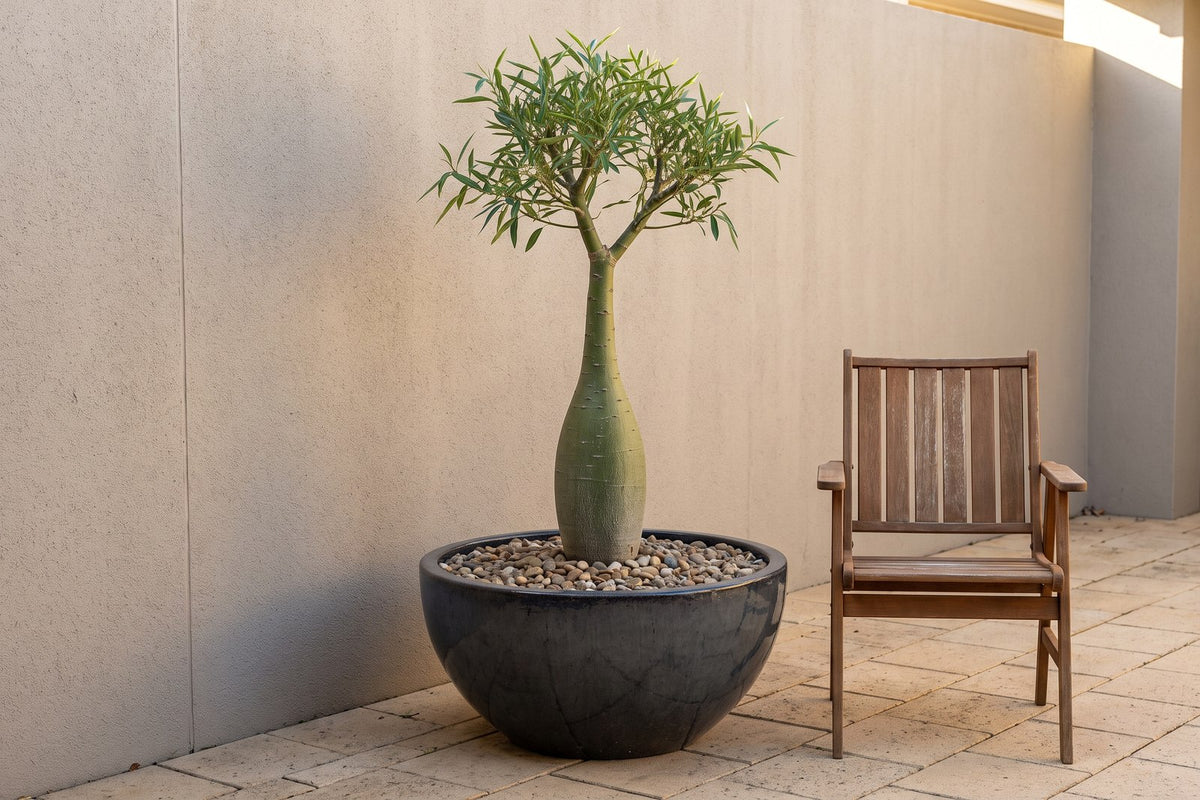
A bottle tree grows well in a large pot for many years, and the restricted roots keep it small while the trunk still swells. Use a free draining mix, water when the top few centimetres are dry, and let it dry further in winter. It is a popular subject for bonsai for the same reason.
Uses in landscaping
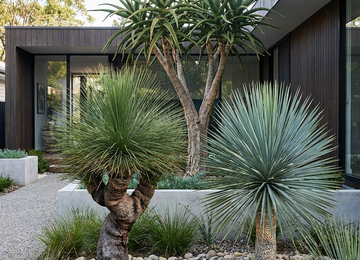
One tree is enough. The trunk is the feature, so give it open ground, low planting around the base and a light at night. Our guide to feature trees for a front yard shows how a single sculptural trunk changes the view from the street. It suits dry gardens with grass trees, cycads, agaves and native grasses, and that mix of presence and low demand is what our step by step native garden guide is built around. On acreage, a row makes an avenue for the next century. Other trees of the same genus do different jobs: the kurrajong for shade and the Illawarra flame tree for red flowers.
History and cultural significance
Aboriginal people ate the roasted seeds and the roots of young trees, and made fibre from the inner bark for nets. Graziers have long fed the leaves and the soft, moist trunk tissue to stock in drought. In Roma, in western Queensland, Heroes' Avenue was planted with bottle trees from 1918 in memory of local men killed in the First World War.
Common pests and diseases
- Root rot. The main risk, in soil that stays wet. Fix the drainage before planting.
- Kurrajong leaf tier. Caterpillars that web leaves together in summer. The damage is cosmetic on an established tree; prune out the webbed clumps on a young one.
- Seed weevils. They damage the pods, not the tree.
Common questions
How fast do bottle trees grow?
Slowly: about 30 to 50 cm a year when young, faster with water and feeding in summer.
How long does the bottle shape take?
The swelling starts to show at about five to eight years and becomes more pronounced with every decade.
Do bottle trees have invasive roots?
They are not known for it, but the trunk becomes very wide, so plant at least 3 to 4 metres from buildings and paving.
Can a bottle tree grow in Melbourne?
Yes. It is slower than in Queensland and needs good drainage and frost protection while young.
Do bottle trees lose their leaves?
Briefly, in late spring before flowering, and in severe drought.
Ready to plant?
Few trees give this much character for so little water. Browse our Australian native trees for a bottle tree to anchor the garden, or the wider drought tolerant plants range to build the bed around it.


