


Monsteras and philodendrons are sold side by side, grown the same way and confused with each other constantly, to the point where one of the most popular monsteras is still called a split-leaf philodendron in half the country. They are cousins in the arum family, not the same plant, and the differences matter when you are choosing one for a particular spot. A monstera is a single big statement that wants light, room and something to climb. Philodendrons are a whole toolbox: trailers for a shelf, tidy clumps for a desk, and tough garden plants for a shaded bed. This guide shows how to tell them apart and which one suits your room.
Quick facts
| Detail | Monstera | Philodendron |
|---|---|---|
| Best known for | Large leaves with holes and deep splits | Heart-shaped or lobed leaves without holes, in green, red, lime and variegated forms |
| Growth habit | A climber with thick aerial roots | Climbers and trailers, plus self-heading clumps that never climb |
| Indoor size | Monstera deliciosa reaches 2 m or more with leaves 60 cm across | From a 30 cm desk plant to a 2 m climber, depending on the kind |
| Light | Bright, indirect light; poor light means small leaves with no splits | Bright, indirect light; the green heartleaf types cope with less |
| Water | When the top 5 cm of mix is dry | When the top 3 to 5 cm of mix is dry |
| Support | Needs a pole or stake from early on | Climbers want a pole; trailers and clumps need none |
| Outdoors | Frost-free shade from Sydney north | Xanadu and its relatives in frost-free shade and part sun |
| Pets and children | Irritating if chewed | Irritating if chewed |
How to tell a monstera from a philodendron
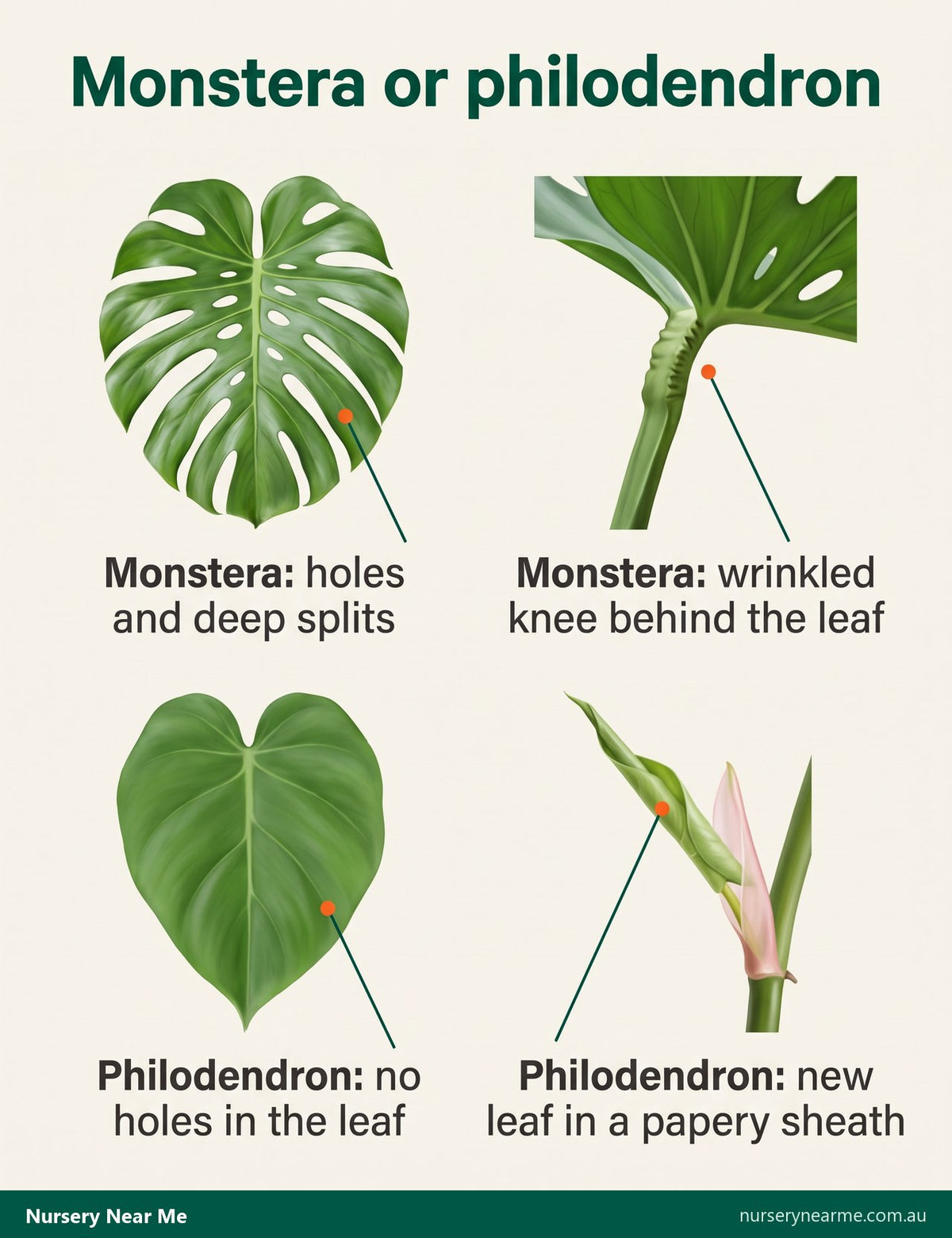
Three checks settle almost every case, and none of them needs a botany degree.
Holes in the leaf
Mature monstera leaves develop holes inside the leaf blade as well as splits running in from the edge. On the fruit salad plant, Monstera deliciosa, the splits reach the margin and the holes sit along the midrib. On the Swiss cheese vine, Monstera adansonii, the holes stay enclosed and the edge is unbroken. Philodendron leaves can be lobed, ruffled or deeply cut, but they do not make enclosed holes.
The knee behind the leaf
Where a monstera leaf meets its stalk there is a short, wrinkled joint that lets the leaf swivel towards the light. Philodendrons do not have it: the stalk runs smoothly into the leaf.
How the new leaf arrives
A new philodendron leaf emerges wrapped in a papery sheath, often pink or red, which dries and falls or sits on the stem. A new monstera leaf unrolls from the stalk of the leaf before it, with no separate sheath.
Two names cause most of the confusion. The "split-leaf philodendron" sold for decades is usually Monstera deliciosa. And the mini monstera is neither: it is Rhaphidophora tetrasperma, a smaller climbing relative with split leaves, grown exactly like a monstera in a third of the space.
Choosing by the spot you have
A bright corner with floor space: monstera. Nothing fills a corner like a Monstera deliciosa on a pole. Give it bright light without hot afternoon sun through glass, a pot at least 30 cm wide and a support, and it becomes a piece of furniture. The cream-splashed Thai Constellation does the same job more slowly and wants the brightest spot in the house. Our monstera care guide covers the routine.
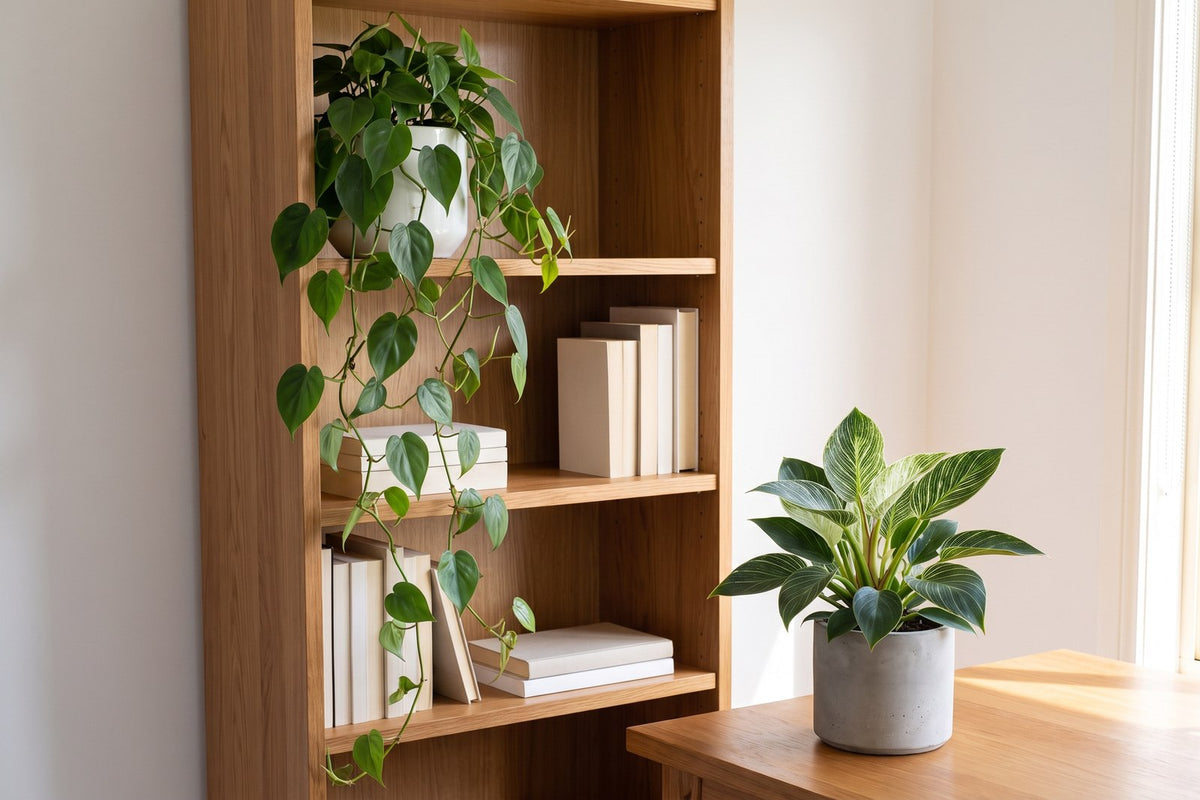
A shelf, a bookcase or a hanging pot: a trailing philodendron. The heartleaf philodendron and the lime-striped Brasil trail a metre or more, forgive a missed watering and hold their leaf size without a pole. They are the plants to choose when the light is only moderate.
A desk, sideboard or tabletop: a self-heading philodendron. These grow as a neat rosette and never run. Imperial Green has broad glossy leaves, Birkin is pinstriped in white, and both stay under a metre for years.
A shaded garden bed or a pot on a covered patio: Xanadu. Xanadu makes a dense mound about a metre high and wide, takes morning sun and is the most used landscape philodendron in the warm half of the country. Monstera deliciosa also grows outdoors in frost-free shade and will climb a tree trunk or a wall if you let it.
Low light. Neither is a dark-room plant. The green heartleaf philodendron tolerates the least light of the group; a monstera in the same position survives but stays small and unsplit.
Care differences that matter

The routine is the same in outline: a chunky, free-draining potting mix, water when the top few centimetres are dry, liquid feed fortnightly from spring to autumn, and a wipe of the leaves now and then. The differences are in the detail.
Support. A monstera needs its pole from the start. Tie the main stem to it, point the aerial roots down into the pot or onto the pole, and the leaves get larger and more split as the plant climbs. Our guide to choosing and setting up a moss pole shows how. Trailing philodendrons can hang or climb as you prefer; the self-heading kinds need nothing.
Light and leaf size. A monstera rewards extra light with bigger leaves and more splits, and punishes a dim spot by reverting to small plain leaves. Philodendrons are more forgiving, although the variegated and red-leaved forms need bright light to hold their colour.
Watering. Monstera stems and roots are thick and store some water, so it prefers to dry a little deeper between drinks. Thin-stemmed trailing philodendrons wilt sooner and recover faster. Both rot if they sit in a saucer of water.
Pruning. Cut a leggy philodendron back to just above a leaf and it branches. A monstera can be shortened the same way, and the piece you remove will root in water if it carries a node and an aerial root. The philodendron care guide has the step-by-step.
Close relatives worth knowing
If you like the look of both, the same family offers more. Syngoniums, the arrowhead vines, are compact climbers with leaves in pink, lime, white and near-black that suit small pots and terrariums. Pothos is the toughest trailer of all for a beginner. And if you want flowers as well as foliage, anthuriums carry glossy red, pink or white spathes for months in the same bright, indirect light. All of them take the same potting mix and watering routine as a philodendron.
Common problems and fixes
A monstera with no splits or holes. Youth or low light. Leaves start plain and split as the plant matures, usually from the fifth or sixth leaf in good light. Move it closer to a window and give it a pole.
Yellow lower leaves and wet mix. Overwatering. Let the pot dry halfway down, empty the saucer and check that the pot drains. One old yellow leaf now and then is normal.
Brown, crisp edges. Dry air from heating or air conditioning, or a pot that has dried right out. Move the plant away from the vent and water more evenly.
Long bare stems between leaves. Not enough light. Cut back to a leaf, move the plant somewhere brighter and replant the cuttings into the same pot for a fuller plant.
Aerial roots heading across the floor. Normal for a monstera. Guide them into the pot or onto the pole; trim them only if they are in the way.
Fine webbing or cottony white tufts. Spider mite and mealybug, both worse in dry indoor air. Wipe the leaves, then treat with a horticultural oil or insecticidal soap and repeat a week later.
Frequently asked questions
Is a monstera a philodendron?
No. Both belong to the arum family and they look and grow alike, but Monstera and Philodendron are separate genera. The plant often sold as split-leaf philodendron is usually Monstera deliciosa.
Which is easier to grow, monstera or philodendron?
The trailing heartleaf philodendron is the easiest of the lot: it tolerates moderate light and irregular watering. Monstera deliciosa is also easy but needs brighter light, more room and a support to look its best.
Are monsteras and philodendrons safe for cats and dogs?
Neither is. Both contain calcium oxalate crystals that irritate the mouth and stomach if the leaves or stems are chewed, causing drooling and vomiting. Keep them out of reach of pets and small children, and see our guide to pet-friendly plants for safer choices.
Can I grow a monstera or a philodendron outside?
In frost-free districts, yes. Monstera deliciosa and Xanadu grow well in shade or filtered light outdoors from Sydney north, and in sheltered courtyards further south. Frost blackens the leaves of both.
Can you eat the fruit of a monstera?
Monstera deliciosa is called the fruit salad plant because its cone-shaped fruit is edible when fully ripe, once the green scales fall away by themselves. Unripe fruit contains the same irritating crystals as the leaves and should not be eaten. Indoor plants rarely flower or fruit.
Ready to plant?
Compare the full range in the monstera collection and the philodendron collection, or browse every option for a bright room in indoor plants. Every plant is sourced from partner nurseries around Australia and delivered Australia wide.
Sources
Plant safety information: NSW Poisons Information Centre and the RSPCA Knowledgebase.


