

An almond tree earns its place twice a year. In late winter, while the rest of the garden is still bare, it covers itself in pink and white blossom that bees work from the first warm morning. In late summer the green hulls split open on the tree and show the nuts inside, ready to shake down. Almonds are closely related to peaches, they are tough once established, and a home tree in the right district gives kilos of nuts for very little work. The right district is the catch. Almonds are trees of dry summers and cold winters, and they sulk in humidity. This guide explains where they crop, which trees need a partner, and how to plant, prune and harvest them.
Quick facts
| Feature | Detail |
|---|---|
| Botanical name | Prunus dulcis, the sweet almond |
| Type | Deciduous nut tree, a close relative of the peach and nectarine |
| Size | 4 to 6 m for standard trees, 4 to 5 m for semi dwarf, 2 to 2.5 m for dwarf trees |
| Position | Full sun, open and airy, sheltered from late frost |
| Climate | Mediterranean, inland and temperate districts with a dry summer and a cold winter; poor in the humid subtropics and tropics |
| Blossom | Late winter to early spring, on bare branches |
| Harvest | Late summer to early autumn, when the hulls split |
| Pollination | Most almonds need a second variety; self-fertile kinds crop alone |
| First crop | Usually three to four years after planting |
Where almonds grow in Australia
Almonds come from the dry hills of western and central Asia, and Australia's commercial orchards show exactly what they like: the Riverland and Adelaide Plains of South Australia, Sunraysia in Victoria and the Riverina in New South Wales. Hot, dry summers, cold winters and low humidity through spring.
Where they do well. Inland and southern districts are ideal: most of South Australia's settled areas, northern and western Victoria, inland New South Wales, the ACT and the south-west of Western Australia. In cooler, wetter places such as Melbourne, the Adelaide Hills and Tasmania the tree grows and flowers well, but a wet spring can spoil the blossom and reduce the crop, so give it the sunniest, most open position you have.
Where they struggle. Coastal Sydney is marginal, and from there north the summer rain and humidity bring leaf and fruit diseases, the winters are too mild to set flower buds properly, and crops are light. In Brisbane, on the Queensland coast and in the tropics an almond is not worth the space. A macadamia or another warm-climate tree from the edible plants range is a better choice there.
Chill and frost. Almonds need a few hundred hours of winter cold to flower well, which most temperate districts supply easily. The dormant tree is very frost hardy. The blossom is not: it opens in late winter, earlier than any other fruit tree, and a hard frost in full flower can take the whole crop. Avoid frost hollows and plant on a slope or near a north-facing wall where cold air drains away. Our guide to frost tolerant plants explains how frost settles in a garden.
Pollination and varieties
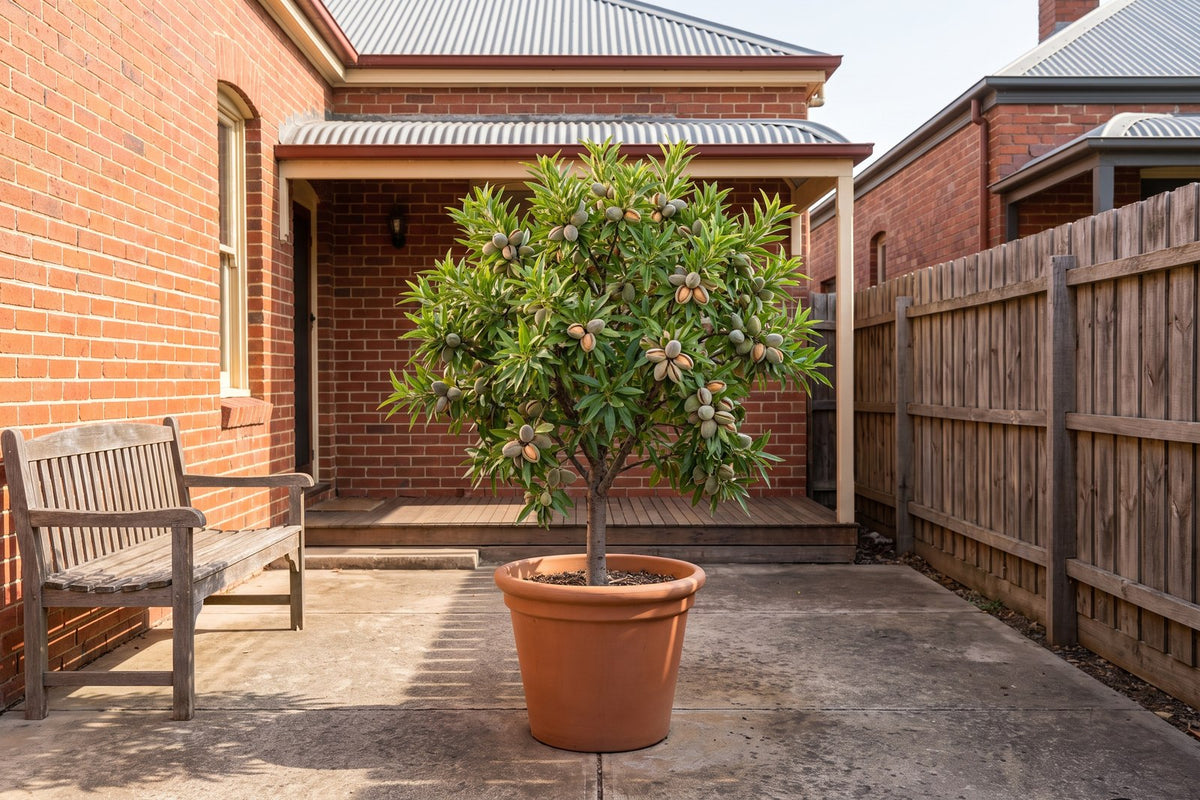
This is the question that decides whether you get nuts. Most traditional almond varieties cannot set a crop with their own pollen. They need a different almond variety flowering at the same time within about 20 m, and bees to carry the pollen between them. A lone tree of that kind flowers beautifully every year and sets a handful of nuts.
Self-fertile almonds changed that for home gardens. A self-fertile tree sets a full crop with its own pollen, so one tree is enough. Bees still do the work, so avoid spraying anything while the tree is in flower.
If you are planting a traditional sweet almond, plant two different varieties, or pair it with a self-fertile tree, which will pollinate it as well as itself.
Almond trees we sell
The full range is in the almond tree collection.
All-In-One. The All-In-One almond is the most widely planted home garden variety: self-fertile, semi dwarf at 4 to 5 m, with soft-shelled, sweet nuts from late summer into early autumn. If you have room for a single tree, this is the safe choice.
Self-pollinating almond. The self-pollinating almond is another one-tree option, a little larger at about 5 m tall and 4 m wide.
Dwarf almond. The dwarf almond tree stays at 2 to 2.5 m, so blossom, netting and harvest are all within reach, and it suits a courtyard or a large pot. A second almond nearby improves its crop.
Sweet almond. The traditional sweet almond tree is the one for a larger garden or a home orchard. Plant it with a partner.
Double Pink flowering almond. The Double Pink flowering almond is grown for its double pink blossom on bare branches, not for nuts. It reaches 3 to 4 m and its budded branches can be cut for a vase. For more spring blossom trees, see the flowering cherries and plums.
Planting an almond tree
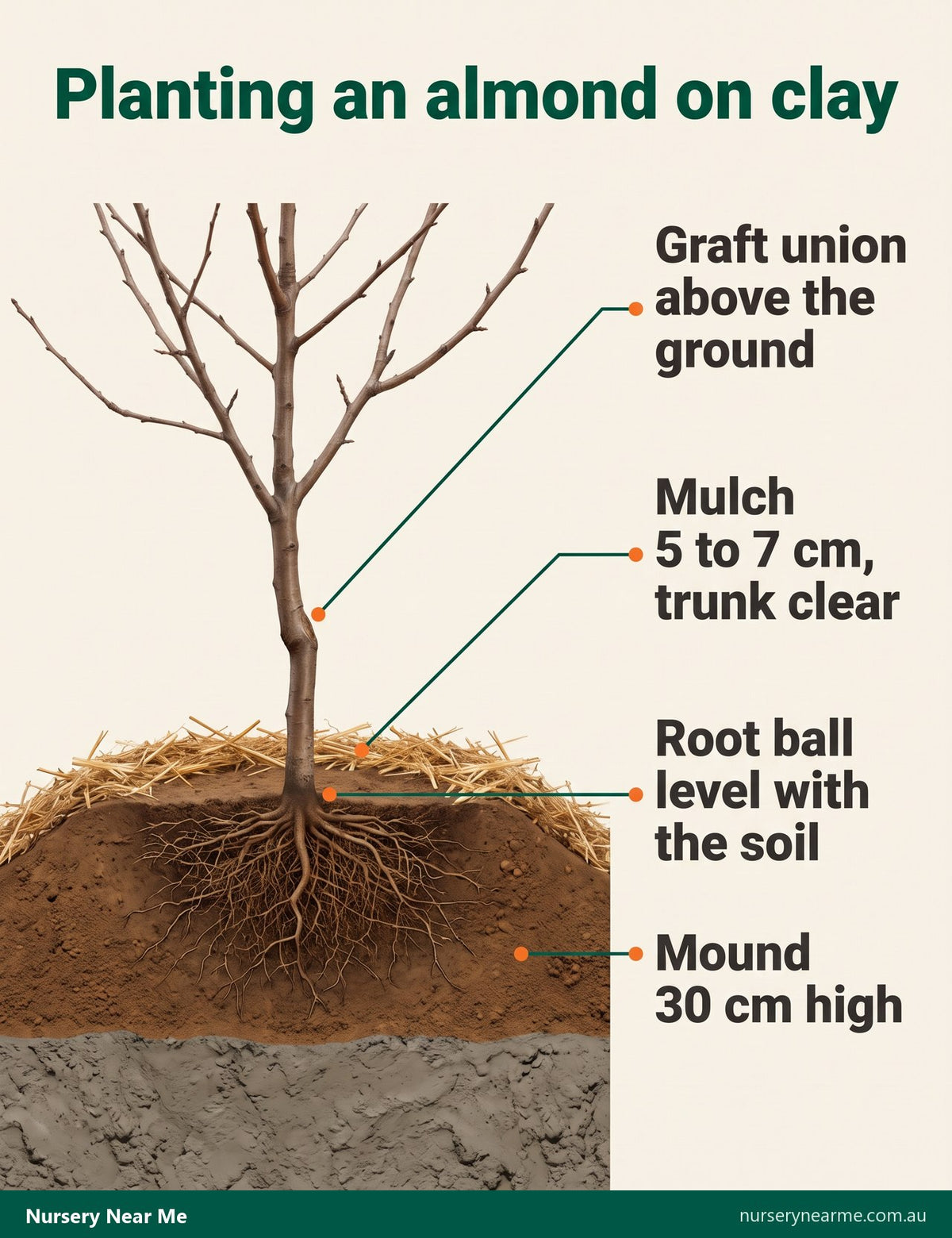
Soil. Drainage matters more than fertility. Almonds grow in sandy, loamy and even stony ground, and they tolerate alkaline soil better than most fruit trees, but their roots rot in ground that stays wet through winter. On clay, plant on a broad mound 30 cm high and at least a metre across. Our guide on preparing soil for planting covers how to test drainage before you dig.
When and how. Plant in winter or early spring. Dig a hole twice the width of the root ball and no deeper, set the tree so the top of the root ball is level with the soil, and keep the graft union, the slight kink low on the trunk, well above the ground. Backfill with the soil you dug out, water in deeply and mulch 5 to 7 cm deep, leaving a gap around the trunk.
Spacing. Allow 5 to 6 m between standard trees, about 4 m for semi dwarf trees and 2 to 3 m for dwarf trees. Trees planted as pollination partners should be within 20 m of each other.
In a pot. A dwarf almond grows well in a pot at least 50 cm wide filled with a quality potting mix. Water it right through summer, because a potted tree has no deep roots to fall back on, and feed it each spring.
Watering, feeding and pruning
Watering. Water young trees weekly through their first two summers. An established almond is among the most drought-tolerant fruit trees and will survive on rainfall in most temperate districts, but surviving and cropping are different things. Deep watering every week or two from flowering until the hulls begin to split fills the kernels. Once the hulls open, stop watering so the nuts dry on the tree.
Feeding. Feed in early spring as growth begins with a complete fertiliser made for fruit trees, and again lightly in early summer. Renew the mulch each spring, as described in our guide to mulching before summer.
Pruning. For the first three winters, shape the young tree to an open vase: three or four main branches evenly spaced around a short trunk, with the centre clear so light and air reach every part. After that almonds need little. They carry their nuts on short spurs that stay productive for several years, so a mature tree only needs dead, crossing and crowded wood removed. Do that on a dry day after harvest in autumn, when cuts heal quickly and fungal diseases are least active. The basic cuts are explained in our pruning guide for beginners.
Harvesting and storing almonds
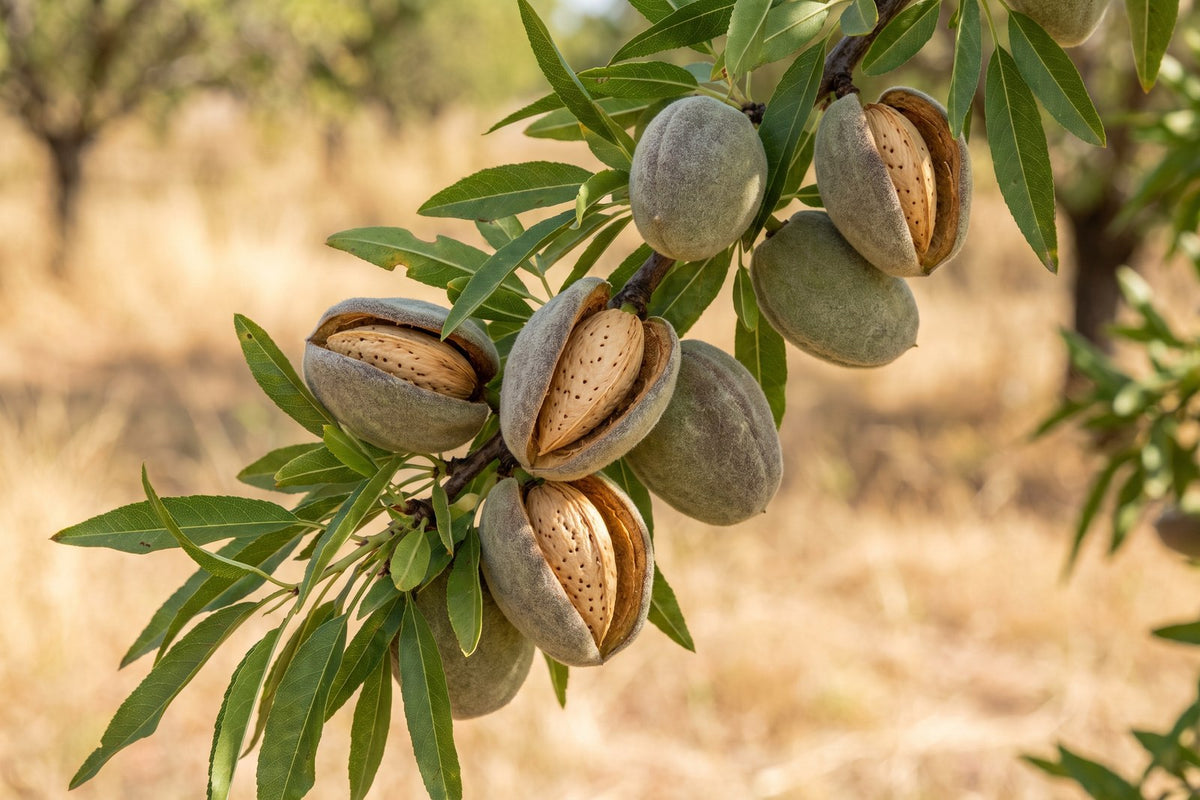
The tree tells you when it is ready. The fuzzy green hull, which looks like a small, flat, unripe peach, splits along its seam and peels back to show the shell. When most of the hulls on the tree have split, usually in February or March, spread a tarp or old sheet under the tree and shake or knock the branches with a pole.
Pull the hulls off within a day or two, then spread the nuts in their shells in a single layer somewhere dry, airy and out of reach of birds and rodents. After one to two weeks, crack a few. A kernel that snaps cleanly is dry and the crop is ready to store. One that bends needs more time. Dry almonds keep for many months in their shells in a cool cupboard, and longer shelled in the freezer.
Home garden trees sold as sweet almonds are safe to eat. Bitter almonds, a different type not sold for eating, contain compounds that release cyanide and should never be eaten raw.
Common problems and fixes
Blossom but no nuts. Usually pollination: a variety that needs a partner, or wet and windy weather at flowering. Frost on open blossom has the same result. Plant a self-fertile tree or a second variety, and choose a site out of the frost.
Birds taking the crop. Cockatoos, corellas and parrots can strip a tree before the hulls split. Net the tree from midsummer with wildlife-safe netting, which has a mesh too small to push a finger through, pulled tight over a frame.
Small holes in the leaves. Shot hole, a fungal disease that is worse after a wet spring, leaves spots that fall out like shotgun pellets. Rake up fallen leaves and apply a copper spray at leaf fall in autumn and again at bud swell in late winter.
Blossom and twigs browning and dying back. Brown rot attacks blossom in damp weather. Prune out affected twigs, remove any dried nuts left hanging on the tree, and keep the centre of the tree open.
Our guide to common plant pests and diseases covers treatment.
Frequently asked questions
Do I need two almond trees to get nuts?
Not if you plant a self-fertile variety such as All-In-One, which crops alone. Traditional almond varieties need a second, different almond flowering nearby.
How long does an almond tree take to produce nuts?
Most trees carry a first light crop three to four years after planting and reach full production at about seven or eight years.
Can almond trees grow in Queensland?
They can crop on the Granite Belt and in the cooler, drier inland south. On the humid coast, including Brisbane, the winters are too mild and the summers too wet for reliable crops.
When do almond trees flower in Australia?
Late winter into early spring, usually from late July to early September depending on the district and variety. They are the first fruit trees of the year to blossom.
Can I grow an almond tree in a pot?
Yes. Choose a dwarf almond, use a pot at least 50 cm wide, and water and feed it regularly through the growing season.
Ready to plant?
Choose your tree from the almond tree collection, and see the wider fruit tree range for the peaches, plums and citrus that grow alongside them. For planting times and techniques that apply to every fruit tree, read our guide to fruit trees for every season. Every plant is sourced from partner nurseries around Australia and delivered Australia wide.
Sources
Almond growing and orchard management: NSW Department of Primary Industries and Agriculture Victoria. Wildlife-safe netting: Victorian Government wildlife pages.


