







African violets have a reputation for dying quietly on windowsills, and most losses trace back to the same misunderstanding: they are treated like any other pot plant. In the wild they grow under forest canopy in East Africa, rooted in moss and in cracks in rock, in filtered light and steady warmth. Growing them indoors means copying that: bright light with little or no direct sun, an open mix that holds air as well as water, and warmth without extremes.
This guide gathers what the African Violet Association of Australia, the African Violet Society of Western Australia, the Australian grower Ruth Coulson, the African Violet Society of America, The Gesneriad Society, the RHS and two university extension services publish on growing these plants indoors. We are a general nursery, not specialist violet growers, so this is a summary of published advice and not first-hand expertise. Each point names its source, the sources are linked at the end, and where they disagree we say so. An afternoon at a society meeting will teach you more than any web page.
Quick facts
| Light | Bright enough to cast a sharp shadow, within about 45 centimetres of a window, shielded from hot direct sun, 10 to 12 hours a day |
|---|---|
| Water | Room temperature or lukewarm, when the surface of the mix is dry, from the top, the saucer or a synthetic wick; an unwicked pot should not be left standing in water |
| Warmth | About 18 to 26 degrees Celsius suits them best; the AVAA gives 15 to 26. Keep plants off cold glass at night and out of the airstream of heaters and air conditioners |
| Mix and pot | An open mix, commonly half potting mix and half coarse perlite, not packed down; a squat pot about a third of the leaf span, usually no more than 100 millimetres for a standard |
| Feeding | Little and often with a soluble fertiliser, and a plain-water flush from the top at regular intervals |
| New plants | Isolate for six to eight weeks (WA society) or 60 to 90 days (AVSA); check centre leaves for mites and flowers for spilt pollen, the sign of thrips |
One plant, two names, and why the wild matters
The African Violet Society of America's research pages record that Baron Walter von Saint Paul collected plants in Tanzania in 1892, the collection that brought them into cultivation, although specimens had been gathered as early as 1884. Hermann Wendland named them Saintpaulia ionantha in 1893. A molecular study published in 2015 by Nishii and colleagues led to Saintpaulia being reclassified as a section of the genus Streptocarpus, so the African violet is now Streptocarpus ionanthus, in the same genus as the Cape primrose. The RHS and North Carolina State University use the new name. The AVSA records the change, still uses Saintpaulia in its beginners' pages and still registers cultivars as African violets, and the common name is unchanged.
The wild plants explain the care. The AVSA says more than twenty species and subspecies were once described and that DNA work reduced them to nine species in 2009, from Tanzania and Kenya, with much of their habitat since cleared for agriculture. It describes them growing under a deep forest canopy, with roots in cracks in limestone or in moss over rock. The Gesneriad Society puts the family at more than 3,200 species and sorts it by what grows underground. Fibrous-rooted kinds, such as violets, Episcia and Columnea, do not go dormant. Most tuberous kinds, such as Sinningia, and most rhizomatous kinds, such as Kohleria, have a dormant period, and the Society warns that a plant that looks dead may only be resting.
Light: which windows work south of the equator
The Australian societies do not name a compass direction. The AVAA puts the plant within 40 to 50 centimetres of a window in filtered light. The WA society asks for the brightest position just short of direct afternoon sun, with a lace curtain or blind to break direct sun, and moves plants back from the glass in the peak of summer and when nights fall to single figures. A little sun is not forbidden: the AVAA allows a little in winter or early in the morning, and Ruth Coulson says a little early morning sun helps while hot summer afternoon light burns.
Overseas window advice needs translating. The RHS puts violets on a north- or east-facing sill from spring to autumn and suggests a south- or west-facing one in winter, which is northern-hemisphere advice. In Australia the sun tracks through the north, so the equivalent is an east or south window in the warm months and a north window in winter, when the sun is low and weak. That translation is ours, not a society's. In practice an east window, with soft morning sun, is the easy choice, and a west window needs a sheer curtain.
The AVAA's "three secrets" article gives the test: light bright enough to cast a sharp shadow, for ten to twelve hours a day. The RHS adds at least eight hours of darkness. Read the plant: the AVSA says leaves reaching upward on long stalks want brighter light, and leaves that bleach and lose colour are getting too much. Where windows fail, the AVAA hangs fluorescent or LED lamps 250 to 300 millimetres above the foliage for ten to twelve hours. The WA society sets its lamps 200 to 250 millimetres above the leaves on a timer, for at least ten hours and preferably twelve, and replaces fluorescent tubes after about twelve months of use. Some overseas sources run lamps longer. The same window logic, for a much larger plant, is in our fiddle leaf fig guide.
Water, wicking and what comes out of the tap
The WA society puts watering first among the things to get right. Ruth Coulson, in an article the society reprints, says the better aerated the mix, the harder the plant is to overwater, and that the answer depends on the mix more than on how much or how often you water. She keeps the mix evenly moist and names two errors: leaving the pot standing in water for hours or days, and letting it dry right out and then saturating it. The AVAA waters when the surface feels dry. The WA society uses water at room temperature or slightly warmer, from the top, the bottom or a wick. If you water into the saucer, tip out what is left: the AVSA's pages give anything from ten to thirty minutes to a few hours for bottom watering.
Water on the leaves is the point the sources argue over. Clemson University says cold water on the leaves causes white blotches and ring patterns, and the RHS avoids wetting any part of the plant. The Australian growers are more relaxed. The AVAA keeps leaves clean with a soft brush or a lukewarm wash under a slowly running tap. Ruth Coulson says water on the leaves does no harm provided it is not icy and cold water is not left on them overnight, especially in cold weather. The AVSA washes plants at the tap with tepid water, blots the centre and keeps the plant out of the sun until it is dry. Better Homes and Gardens Australia waters only the mix. The common ground is that lukewarm water does no harm, and that cold water, or leaves left wet in the cold or in the sun, does.
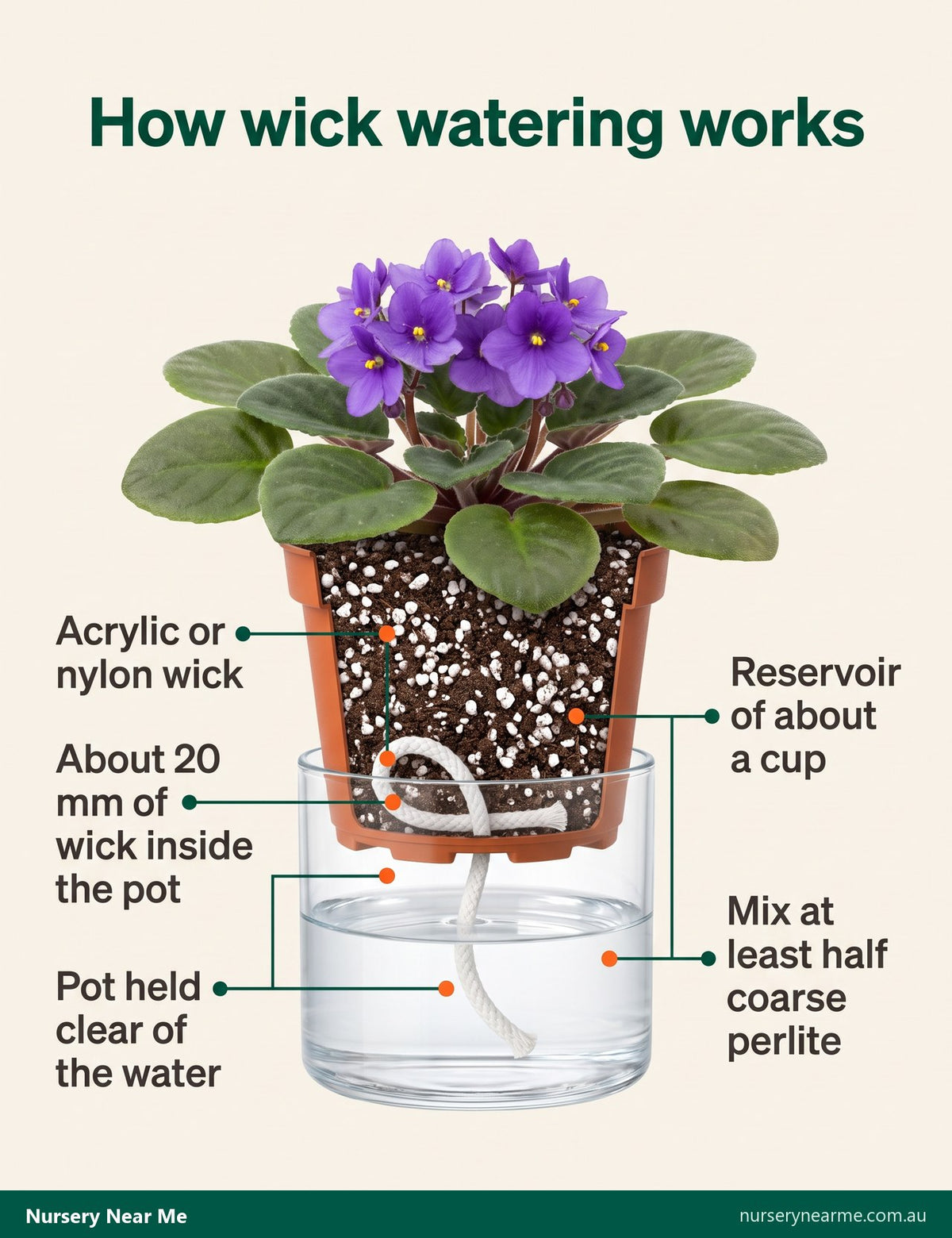
Wick watering is the AVAA's second secret. A cord of acrylic or nylon (natural fibres rot) runs from about 20 millimetres inside the pot, out through the drainage hole and into a reservoir below, with the pot held clear of the water. A reservoir of about a cup lasts a standard plant more than a week even in summer. For wicking the AVSA asks for a mix that is at least half coarse perlite and prefers a plastic pot, because a clay pot loses water through its walls. Salts build up whichever way you water. The WA society waters from the top at least every third watering to wash them down, and The Gesneriad Society flushes with plain water once a month.
Town water grows good violets. The WA society asks for drinking-quality water stood overnight to shed chlorine, and calls rainwater ideal. Chloramine, which some Australian supplies use, does not dissipate on standing, so regular flushing matters more than the standing does. Softened water carries salts and is out (AVSA, WA society). The AVAA wants the mix neutral or slightly acid.
Warmth, humidity, air conditioners and the seasons
The figures differ a little. The AVAA gives 15 to 26 degrees Celsius. The WA society's ideal is 18 to 21 at night with a rise of three to six degrees by day, and it says growth slows after an extended period below 15. The RHS gives 18 to 24 by day and 16 at night. The AVSA prefers about 18 to 27: it says cell division nearly stops below about 18, and that above about 27 the foliage begins to break down and turn glassy. Clemson University allows warmer days than that.
On humidity the AVSA says 30 to 60 per cent encourages flowering and that fungal diseases are more likely when it is high. The WA society's beginners' page asks for 40 to 50. The AVAA asks for at least 60, and notes that this is seldom a problem in Sydney outside heated rooms in winter. Better Homes and Gardens Australia says most Australian homes sit between 30 and 50. The usual remedies are grouping plants together and standing pots on a tray of wet pebbles, above the water line (RHS, Gesneriad Society). The RHS advises against misting, which marks the leaves and encourages mildew. The Gesneriad Society says to avoid hot or cold draughts from heating and cooling vents; evaporative coolers add humidity violets like but blow the same draught.
Climate changes the emphasis, and the notes in this paragraph are our reading of the sources for Australian conditions. In the tropics and subtropics humidity comes free, and heat and mildew are the problems: choose a cooler, bright window and keep the air moving. On the warm temperate coast violets are as easy as they get, and only heated rooms in winter need the pebble tray. In the cool south, winter glass is the enemy: draw the curtain behind the plants at night or move them off the sill. Ruth Coulson prefers not to start leaf cuttings in late autumn or winter unless the growing area is really warm, and warns that variegated plantlets started then can come up entirely white. Inland and in Perth and Adelaide, move plants back from the glass on days above 40 degrees. The AVSA notes that clay pots keep roots cooler in hot climates through evaporation, though they dry faster and do not suit wicking.
Potting mix, pots and feeding
The AVAA's "three secrets" article says the major component of a violet mix should be air. Ruth Coulson wants at least half the grains around 3 millimetres across, and never squashes the mix down around the roots. The AVSA describes a common mix of one part potting mix to one part coarse perlite, not packed. The AVAA lists peat, vermiculite, perlite and charcoal. Overseas institutions use denser mixes and firm them in, so there is more than one way to do it; what the specialist growers share is an open, airy mix. A bag of premium potting mix (Scotts Osmocote 50 litre) lightened with an equal volume of perlite is the simplest Australian version.
Pots stay small. The AVAA and the AVSA use the one-third rule: a squat pot about a third of the leaf span. The AVAA pots on one size at a time until the plant reaches the usual 10 centimetre pot. Ruth Coulson keeps a mature standard in a pot no more than about 100 millimetres across and less than that in height, the WA society says the same, and the RHS allows a shallow 12 centimetre pan for a very large plant. The AVSA warns that an oversized pot encourages leaves without flowers and may lead to rot. The AVAA finds plastic pots convenient and satisfactory. Decorative ceramic pots rarely drain, so growers drop the plastic pot inside one. A glazed indoor pot in a range of sizes makes a good cachepot provided the inner pot comes out to drain; other shapes sit in our indoor pots collection.
Feeding follows the AVSA's rhyme, "weekly, weakly": a soluble fertiliser at reduced strength with every watering. How much to reduce it depends on the label. The AVSA cuts a monthly label rate to a quarter for use at every watering. The WA society uses general fertilisers at quarter strength at every watering, but fertilisers made for African violets at the strength the maker recommends. The sources differ on the formula: the WA society prefers one higher in phosphorus and says a high-nitrogen fertiliser gives leaves at the expense of flowers, while the AVSA now recommends a balanced fertiliser and says too much phosphorus can damage foliage. Ruth Coulson's main point is not to overdo it. Fish emulsion clogs wicks (WA society).
African violets and the other gesneriads
African violets: standards, miniatures and trailers
- Standards. One crown, symmetrical rows of leaves, flowers above the foliage. The AVSA classes plants by overall diameter: a miniature measures 6 inches (about 15 centimetres) or less, a semiminiature more than 6 and up to 8 inches (about 20 centimetres), and a standard more than 9 inches (about 23 centimetres).
- Miniatures and semi-miniatures. The same plant scaled down. Ruth Coulson keeps miniatures in pots no larger than 50 millimetres and semi-miniatures in 65 or 70 millimetre pots. Pots that small dry quickly.
- Trailers. The AVSA describes trailing as a trait inherited from the species: true trailers often have more space between the leaves, and a show trailer must be a single plant with at least three crowns. Pinch the centre to encourage crowns, in a broad shallow pan or a pot a third of the plant's diameter.
- Chimeras. A stripe down each petal; the AVSA warns they rarely come true from a leaf and are propagated from suckers or flower stalks.
Streptocarpus, the Cape primrose
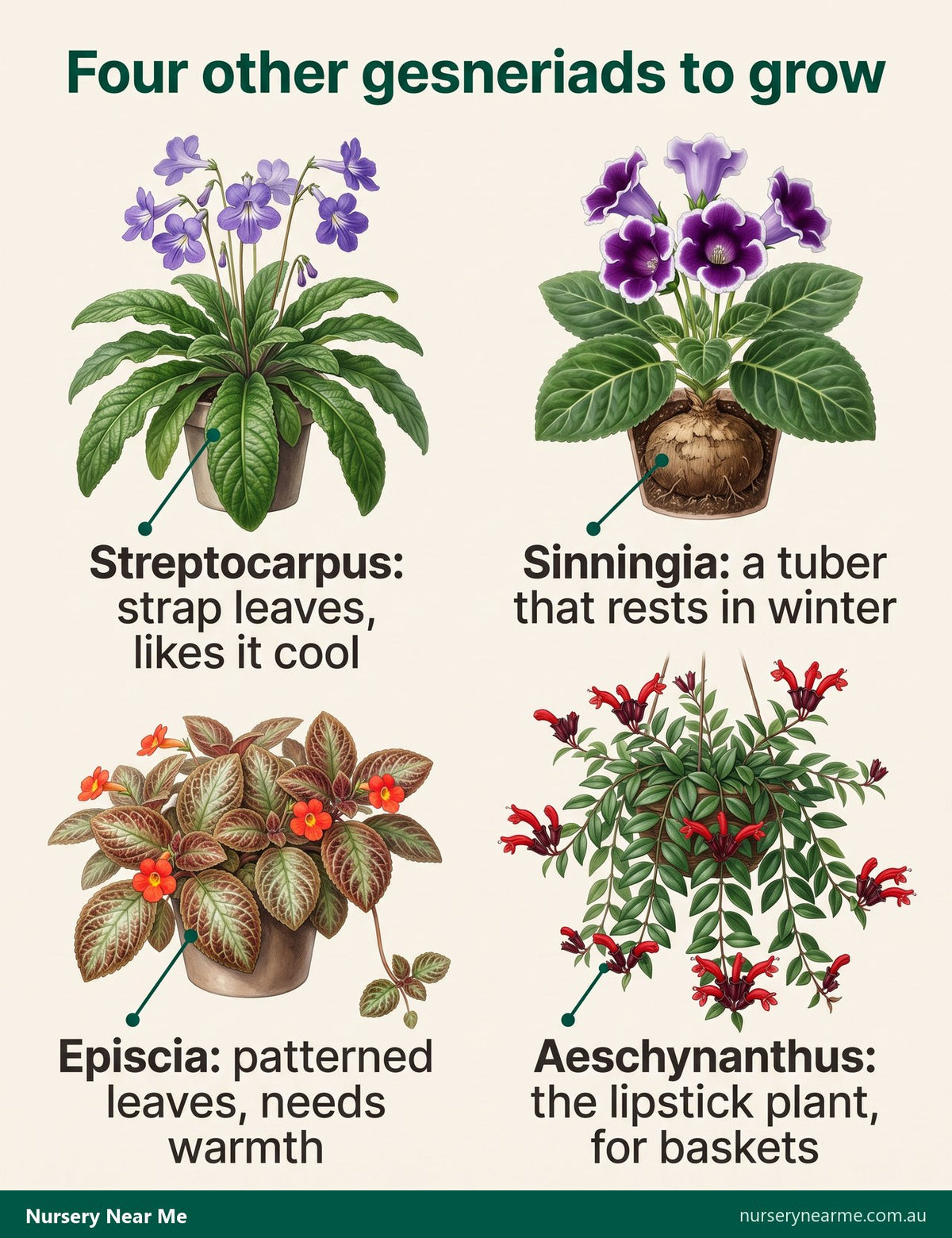
A large genus from southern Africa. The kinds grown indoors typically have strap-like leaves in a rosette. The Gesneriad Reference Web says that in general they prefer coolish temperatures and do poorly in hot weather, and that they want an open, well-drained medium kept evenly moist but never continuously wet. That suggests they will be easier in the cool south than through a Brisbane summer. In window light, flowering falls away as the days shorten. The RHS uses wide shallow pots, a high-potash feed at half strength fortnightly in the growing season, and water only when the compost is dry in winter.
Sinningia: gloxinias and the miniatures
About 75 species, most of them native to Brazil and most with a tuber (Gesneriad Reference Web). The florist's gloxinia is Sinningia speciosa, and S. pusilla, S. concinna and S. minima are very small, stemless rosettes. On the New South Wales coast Ruth Coulson grows the mid-sized species mostly outdoors or in a shadehouse, and says a very bright position indoors will do. She uses squat pots no more than 30 millimetres wider than the tuber and lets the plants go dormant in winter. She sits a dormant tuber at or partly above the surface, with a little moisture and protection from freezing and flooding. The Gesneriad Society keeps dormant plants mostly dry until growth resumes. A dormant tuber is not dead.
Episcia, the flame violet
Creeping plants from tropical America, grown for patterned leaves in green, bronze, silver and pink. Most have small orange-red flowers. The Gesneriad Reference Web says they generally need fairly high humidity and warmth and do not tolerate cool temperatures or dry air, and that outside a greenhouse most of the pink and white cultivars are best grown in a protected environment such as an enclosed bowl. On that description they should be easier in Brisbane and Darwin than in the south, where they need a warm room. New plants are grown from the stolons (Gesneriad Society).
Aeschynanthus and Columnea: the basket gesneriads
Both are usually grown in hanging baskets. Aeschynanthus, the lipstick plant, is a genus of about 150 epiphytes from southern Asia with curved, tubular flowers, generally red or orange. The Gesneriad Reference Web says it does well in a bright window without long periods of direct sun, and that drying for a few days between waterings does no harm. Columnea is the largest gesneriad genus of tropical America at around 300 species, most of them epiphytes, from humid climates where the temperature never approaches freezing, so indoors it wants warmth and humidity. For stem cuttings The Gesneriad Society suggests at least three leaf nodes, and adds that many gesneriads root from smaller pieces.
Kohleria
Velvety-leaved plants found from Mexico to Peru and across northern South America, with spotted flowers, grown from scaly rhizomes. The Gesneriad Reference Web calls them relatively easy: a light peat and perlite mix kept evenly moist, in bright light. The species usually have a distinct dormancy, and many newer hybrids have a short one or none. Rhizomes can be lifted, stored and replanted.
Primulina, once Chirita
Plants of limestone country in western and southern China and northern Vietnam, with often leathery, patterned leaves (Gesneriad Reference Web). In 2011 the species of Chirita were divided among five genera, and many of them went into Primulina, so older collections may still carry Chirita labels. The Gesneriad Society propagates primulinas from offsets.
Companions for the same windowsill
Rex begonias such as Begonia rex Kotobuki and the spiralled Begonia Escargot take the same filtered light and pebble-tray humidity, so one regime serves both. A flowering anthurium such as Anthurium White Winner holds its spathes for months in the same light and warmth, and being larger it can take a ceramic indoor pot or a ceramic pot on a stand beside the sill. More are in our indoor flowering plants and indoor plants collections.
What to watch for
- Hot direct sun through glass, especially a west window in summer. The AVSA says leaves that bleach and lose colour are getting light that is too intense.
- Cold water on the leaves. Clemson University says it causes white blotches and ring patterns. Cold glass on a winter night chills the plant in the same way.
- Botrytis. The WA society's diagnosis chart describes centre leaves that are grey and hairy with a cottony white or grey web in the centre. The same grey, hairy centre without a web is the chart's sign for mite.
- Root and crown rot. The WA society says crown rot is avoided by not overwatering. Roots should be white or semi-transparent (Ruth Coulson). For root rot the AVSA lets the root ball dry on an absorbent towel or paper and, if the roots are darkened and matted, trims them and repots quickly, which may help. Ruth Coulson cuts the roots off entirely and re-roots the crown in a small pot.
- Unquarantined new plants. The AVSA isolates arrivals for 60 to 90 days, the WA society for six to eight weeks.
- Cyclamen mite. The AVSA calls it the most feared of violet pests: the centre of the plant twists and stunts and the bud stems distort. It says plants can be treated but that disposal is often the wiser choice; a leaf can be kept if it is rinsed under a gentle stream of tepid water and kept enclosed until the plantlets are big enough to pot. The WA society says plants with mite or mealybug are better destroyed.
- Thrips. Spilt pollen on the petals is the sign (WA society). They spread impatiens necrotic spot virus, which has no cure (AVSA), and the WA society breaks the cycle by removing every flower and bud for a month or two.
- Mealybugs. White cottony specks in the leaf axils. In the root ball, the WA society's chart describes white fuzzy areas or slow-moving, oval, whitish insects about 1.5 millimetres long.
- Powdery mildew. White powder on leaves and flowers. The AVSA links it to still air and a wide gap between day and night temperatures, and says many growers run a fan on low around the clock. The WA society suggests a regular light preventive spray of about 100 millilitres of full cream milk in two litres of water.
On the household side the news is good. The ASPCA classes the African violet (Saintpaulia species) as non-toxic to cats, dogs and horses, as does North Carolina State University, which is why it appears in our guide to pet-friendly plants for the home. The other gesneriads are not all on those lists, so keep them out of reach of a chewing pet.
Getting it right
Repotting
The WA society says a plant that has not been repotted in the last twelve months is unlikely to flower as well, and repots each year in the warmer months, preferably spring. The AVSA repots once or twice a year, usually into the same size pot with fresh mix. The RHS repots less often, every two to three years. The signal is a neck, bare stem showing below the lowest leaves. For a short neck the AVSA removes the lowest leaves, takes about 25 millimetres off the bottom of the root ball, sets the plant back down in the same pot so the neck is covered, and fills in with fresh mix at the top. A long neck is handled differently: the AVSA cuts the crown off and re-roots it, and warns that burying a long neck in a bigger pot can rot the plant.
Grooming, suckers and show culture
Societies judge a rosette violet as a single crown, and Ruth Coulson notes that a violet allowed to grow many crowns will normally not flower as well. Suckers, the small shoots in the leaf axils and around the base, come out as soon as they are seen; trailers are the exception, and the AVSA notes that suckers can be rooted as new plants. Grooming is the rest: spent flowers and finished stalks removed, the lowest leaves taken off as they fade, the leaves kept clean with a soft brush or a lukewarm wash (AVAA), and the pot turned regularly so the plant grows evenly. For a show, the WA society reprints a South Australian grower's schedule in which all flowers and buds are removed until about six to eight weeks before the date.
Propagation from a leaf
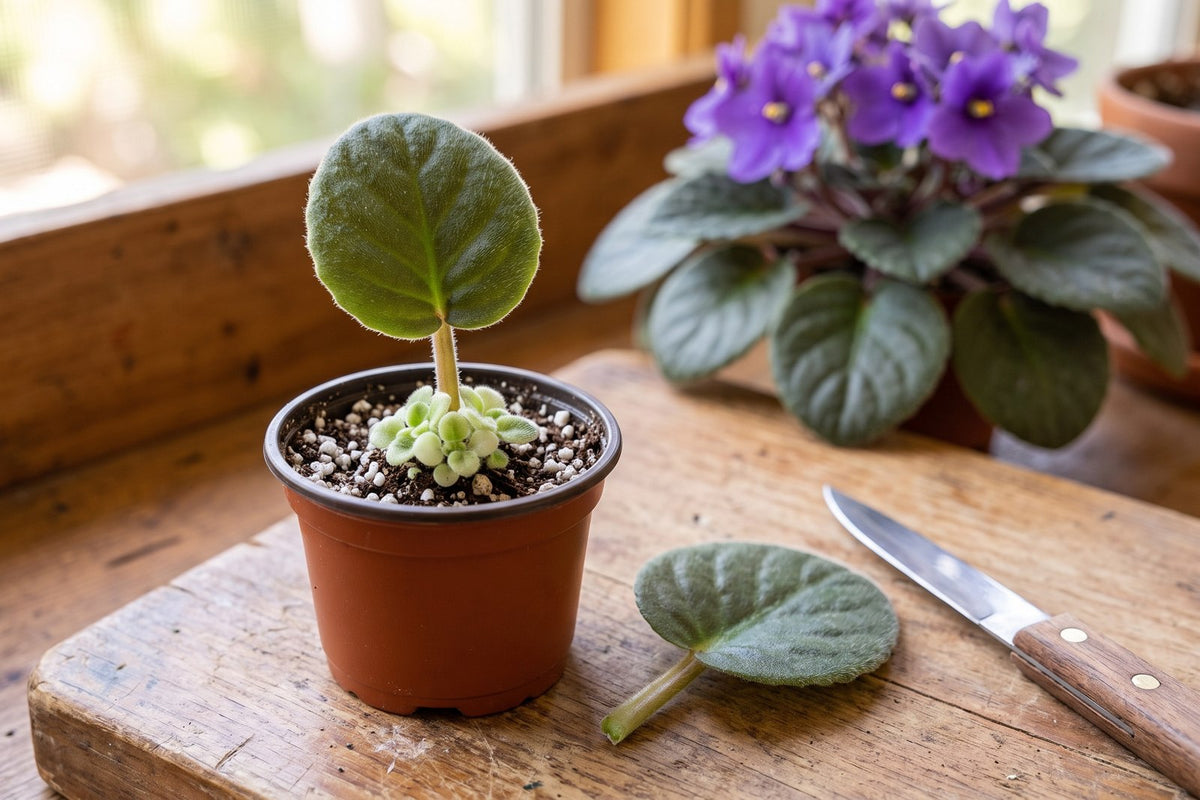
- Choose a healthy leaf from the middle rows, neither the oldest nor the youngest (Ruth Coulson); on a variegate, the greenest one. The AVSA says leaves root at any time of year and fastest in warmth; Ruth Coulson avoids late autumn and winter unless the growing area is really warm.
- Cut the stalk on a slant. The sources leave different lengths: 10 to 20 millimetres (Ruth Coulson), 20 to 30 (AVAA), 25 to 50 (AVSA).
- Set it about 10 millimetres deep in an open mix, or in perlite and vermiculite alone, in a 60 to 70 millimetre pot (Ruth Coulson).
- Keep it warm in bright, indirect light. Some growers cover the pot with a plastic bag, which Ruth Coulson uses to protect a leaf started in cold weather. Plantlets show from about six weeks (AVAA), six to eight (AVSA) or four to five at 18 degrees (RHS).
- Separate when the clump is 60 to 80 millimetres high (Ruth Coulson) or 6 to 10 centimetres (AVAA), one plantlet to a small pot. A leaf can give a dozen or more plants (AVAA).
The other gesneriads follow The Gesneriad Society's notes. Streptocarpus leaves are cut along both sides of the midrib and the halves set cut edge down; the RHS and the Gesneriad Reference Web also cut leaves across into 5 centimetre sections. Episcia stolons and Primulina offsets are removed and rooted like cuttings. Sinningia crowns are cut from the tuber, and rhizomes are divided into sections.
When they will not flower
The WA society reprints an article listing nine causes: poor health, pests or disease, no new growth (flowers come from new leaf axils), too many suckers, no repotting in the last year, no fertiliser, a high-nitrogen fertiliser, drying out too often, which kills the root hairs, and the wrong light, temperature or humidity. It says lack of light is the reason most often given but by no means the only one. Ruth Coulson says light is the first thing to look at.
A word of caution
This guide is a summary of what specialist societies and institutions publish, compiled by a nursery that does not specialise in these plants. The figures come from three countries and do not always agree; where they differ, start with the Australian figure and let your own room decide. Some society pages still name pesticides that may no longer be registered in Australia, so check the current label and the APVMA register before spraying anything, and test any spray on one leaf first. For a spreading problem, a violet society will identify mites, thrips and virus faster than any web page, and the societies listed below welcome beginners.
Sources and societies
- African Violet Association of Australia, Sydney meetings and show
- AVAA: growing African violets, light, temperature, mix, pots, propagation
- AVAA: the three secrets, shadow test, wick watering, mix
- Hunter Valley African Violet Society, NSW violet and gesneriad meetings
- African Violet Society of Queensland, Brisbane society, founded 1966
- African Violet Society of Western Australia, Perth society and care pages
- AVS of WA: African violets 101, temperature, humidity, water, feeding, quarantine
- AVS of WA: making your violets flower, nine reasons violets stop flowering
- AVS of WA: watering African violets, aerated mix beats watering rules
- AVS of WA: diagnosing sick plants, mite, thrips, mealybug, rot symptoms
- AVS of WA: growing with artificial light, lamp height, hours, timers
- AVS of WA: summer with your violets, flushing salts, show disbudding schedule
- Ruth Coulson: African violet care, light hours, wicking, pot size
- Ruth Coulson: how not to kill an African violet, mix grain size, overfeeding, roots
- Ruth Coulson: growing African violets from leaf, leaf cuttings, separating plantlets, winter
- Ruth Coulson: too many heads, suckers, single crowns, trailers
- Ruth Coulson: growing sinningias in Australia, tubers, dormancy, NSW coast
- Ruth Coulson: African violet how-to, water on leaves, washing
- Better Homes and Gardens Australia: African violets, humidity in Australian homes
- African Violet Society of America: Violets 101, light, temperature, mix, feeding, diseases
- AVSA: introduction to trailers, trailers, crowns, show requirements
- AVSA: all about pots, one-third rule, pot materials
- AVSA: watering African violets, wicking, water quality, salts
- AVSA: insect and mite pests, mites, thrips, quarantine period
- AVSA: propagation with leaf cuttings, leaf choice, timing, chimeras
- AVSA: African violet terms, size classes
- AVSA: repotting a violet with a neck, necks, re-rooting a crown
- AVSA: science and research, discovery, 2015 reclassification, conservation
- The Gesneriad Society: gesneriad culture, temperature, light, humidity, feeding
- The Gesneriad Society: gesneriad propagation, leaf sections, stolons, rhizomes, cuttings
- The Gesneriad Society: gesneriad classification, tuberous, rhizomatous, fibrous rooted
- The Gesneriad Society: FAQs, family size, Gesner, dormancy
- RHS: African violets growing guide, windows, compost, propagation, name change
- RHS: Streptocarpus growing guide, feeding, winter rest, leaf sections
- Clemson University HGIC: African violet, cold water blotches, mix, pests
- NC State Extension: Streptocarpus ionanthus, accepted name, non-toxic to pets
- ASPCA: African violet, non-toxic to cats and dogs
- Gesneriad Reference Web: Streptocarpus, genus, cool temperatures, Saintpaulia included
- Gesneriad Reference Web: Sinningia, species, tubers, gloxinia, miniatures
- Gesneriad Reference Web: Episcia, humidity, warmth, variegated forms
- Gesneriad Reference Web: Episcia genus page, stolons, cold and dry air
- Gesneriad Reference Web: Aeschynanthus, epiphytes, light, drying between waterings
- Gesneriad Reference Web: Columnea, species count, warmth, humidity
- Gesneriad Reference Web: Kohleria, rhizomes, dormancy, easy culture
- Gesneriad Reference Web: Primulina, limestone origin, leaves
- Gesneriad Reference Web: Chirita, the current situation, the 2011 division of Chirita


