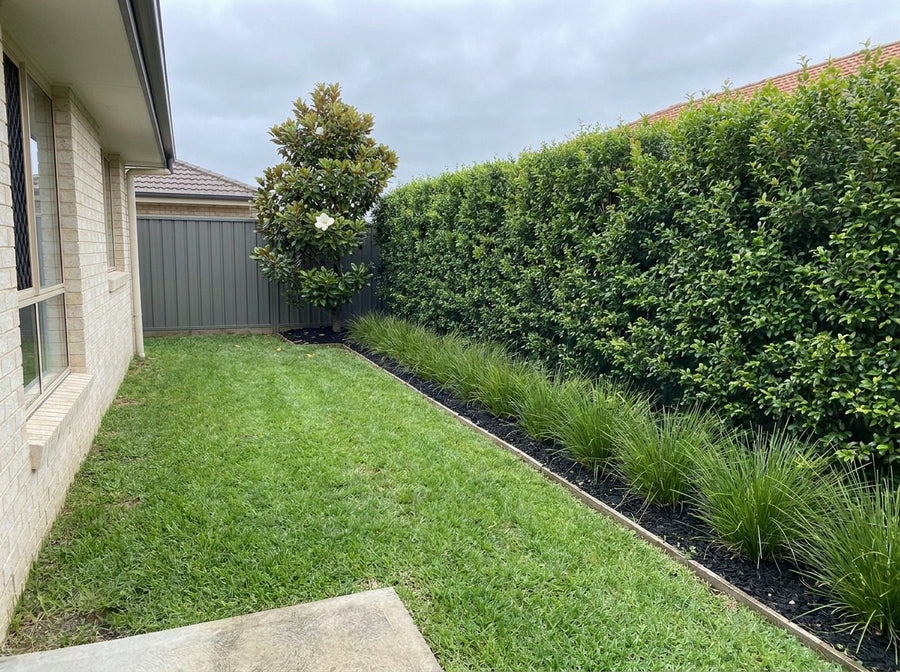
Callistemon 'Endeavour' (Callistemon citrinus 'Endeavour') is the bottlebrush to plant when you want a screen that also flowers hard. It reaches about 3m tall and 2.5m wide, carries large bright red brushes in spring and again in autumn, and shrugs off the conditions that finish most hedging plants: salt wind, drought, frost and ground that stays wet.
Why you'll love it
-
Two flowering seasons, not one. A heavy flush of red brushes in spring, then a second show in autumn.
-
Honeyeaters find it within days. The flowers are loaded with nectar, pulling in birds, bees and butterflies from the first season.
-
Wet feet and drought, both. It handles poorly drained clay and boggy corners, then holds up through a dry summer. Few shrubs manage either end of that range.
-
Coastal and cold hardy. Salt laden wind does not burn it and frost does not check it, an unusual combination in one plant.
-
Fast, low maintenance cover. It grows quickly and needs nothing beyond a trim after flowering.
Where it works best
Screening and hedging. Plant 1.5m apart in a single row for a screen 2m to 3m high. Tighter spacing does not close the gap any faster and makes watering and feeding harder.
Windbreaks and coastal gardens. A double staggered row at 1.5m filters wind instead of blocking it, which is what an exposed block needs.
Wet ground and drainage lines. It is a genuine answer for a low corner of the yard or a swale that stays damp after rain.
Growing Callistemon Endeavour in Australia
Position and climate. Full sun for the heaviest flowering; part shade works but the growth stays looser and the flush is lighter. It performs across subtropical, warm temperate, cool temperate and Mediterranean gardens, from coastal Queensland down through Melbourne and Perth, and it is frost hardy once established.
Soil. Almost anything. Sand, loam and heavy clay all work, wet or dry, which is why councils plant it. Mulch 75mm deep and keep it clear of the stems.
Water and feed. Deep soak twice a week through the first summer, then only in extended dry spells. Use a low phosphorus native fertiliser in early spring, since standard fertilisers can damage native roots.
Pruning. Trim lightly straight after each flush, cutting behind the spent brushes. That keeps the base furnished. It reshoots from old wood, so a neglected plant can be cut back hard and recover.
What to expect when it arrives
It is grown in seven sizes. Tube, 140mm and 200mm plants are young and single stemmed, and they are the value choice for a long boundary: slower to close, but quick to establish. The 300mm and 400mm pots are the usual middle ground, while the 500mm and 45L plants arrive already branched with real height on day one.
Plants are packed to travel upright and delivered Australia wide, with delivery from $29.95. Advanced and large stock is freighted at cost. Expect a quiet few weeks after planting, then strong new growth. Every plant carries our 30 day healthy plant guarantee.
Plant care guides and related reading
Common questions
How far apart should I plant it for a hedge?
1.5m apart in a single row. At that spacing the canopies meet without shading each other out at the base, which is where hedges go thin.
How fast does it grow?
Around 40cm to 60cm a year in a warm garden with water behind it, slower in cool southern districts and slower again in shade.
Will it really cope with a wet spot?
Yes, within reason. It tolerates ground that stays damp and floods briefly after rain, though permanently standing water will still kill it. On heavy clay, planting on a low mound is cheap insurance.
Do I have to prune it to get the autumn flowers?
Not strictly, but it helps. A light trim after the spring brushes finish pushes fresh growth, and that new wood is what carries the autumn flush.
Western Australia: this species has escaped from gardens and naturalised in WA, where it competes with local bushland plants. We do not recommend it for gardens in the south west of WA. Please choose a local alternative.