

Proteas and their relatives the pincushions come from the Cape of South Africa, a region of poor, sandy, acid soils, dry summers, constant wind and brilliant light. Much of southern Australia has exactly those conditions, which is why proteas grow so well here and are farmed here as cut flowers. In the right spot a protea is among the lowest-maintenance flowering shrubs you can plant: no feeding, little watering once established, and armfuls of long-lasting flowers through the cooler months. In the wrong spot it dies quickly. This guide sets out what proteas and pincushions need, where they will and will not grow, and the varieties we sell.
Quick facts
| Feature | Detail |
|---|---|
| Botanical names | Protea (proteas, sugarbushes) and Leucospermum (pincushions), family Proteaceae |
| Size | Most garden kinds 1 to 2.5 m tall and wide |
| Flowers | Proteas mainly autumn to spring; pincushions late winter to early summer |
| Position | Full sun in an open position with moving air |
| Soil | Acid, sandy or gravelly and fast draining; never waterlogged |
| Feeding | None, or a low-phosphorus native fertiliser very sparingly |
| Climate | Dry-summer and temperate districts; poor in the humid subtropics and tropics |
| Frost | Proteas take light to moderate frost once established; pincushions light frost only |
Where proteas grow well, and where they do not
Good districts. Proteas are at their best where summers are dry and the air moves: coastal and hills districts of South Australia, most of southern Victoria, the south-west of Western Australia, northern and eastern Tasmania, and the tablelands, south coast and well-drained coastal sands of New South Wales. Sloping blocks, sandy soils and exposed, windy sites that defeat other shrubs often suit them perfectly.
Difficult districts. Humidity is the enemy. In the humid subtropics, including coastal south-east Queensland and the far north coast of New South Wales, warm, wet summers bring root rot and leaf diseases, and proteas are usually short lived unless they are grown on the cooler, drier ranges or in pots under an eave. In the tropics they are not worth attempting. Heavy clay and alkaline soils are unsuitable anywhere.
Frost. Established proteas such as Pink Ice tolerate frosts of a few degrees below zero. Pincushions are more tender and their flower buds are damaged by anything more than a light frost, so in cold inland gardens give them a sheltered, north-facing position.
Proteas and pincushions we sell
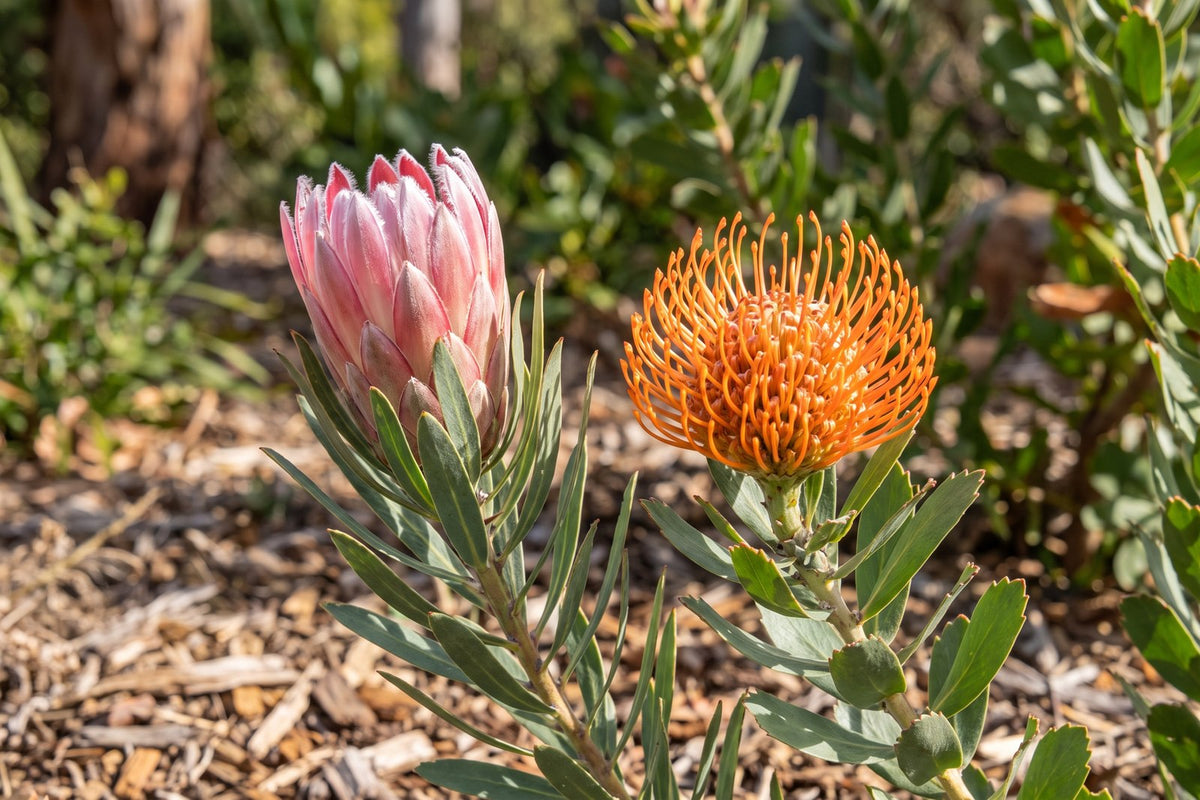
The whole range is in the protea and pincushion collection.
Pink Ice. Pink Ice is the protea to start with and the most widely grown in Australia. It is a vigorous, forgiving hybrid of 2 to 3 m with silvery-pink flowers, their bracts tipped with a soft white fringe, from autumn through winter and into spring. It tolerates a wider range of soils than most and makes a fine informal screen or windbreak.
White Ice. White Ice has the same shape and habit with creamy white flowers, and the two look good planted together.
King Protea. The king protea is the national flower of South Africa and carries the largest flower heads in the genus, bowl-shaped and up to 25 or 30 cm across, on a low shrub of 1 to 1.5 m. It is slower than Pink Ice and takes a few years to begin flowering.
Little Prince. Little Prince is a compact king protea, under about 1 m, with smaller red-pink flower heads produced over a long season. It is the best protea for a pot.
Pincushions. Leucospermums have rounded flower heads made of hundreds of stiff, curving styles, like pins in a cushion, in fiery yellows, oranges and reds from late winter to early summer. They are rounded shrubs of about 1 to 1.5 m, superb on a sunny bank and loved by honeyeaters. We sell Blooming Gold, Blooming Orange, Carnival Orange and the yellow Goldie.
The third branch of the family grown in gardens, grown mostly for its coloured bracts and foliage, has its own range: see leucadendrons.
Soil and planting
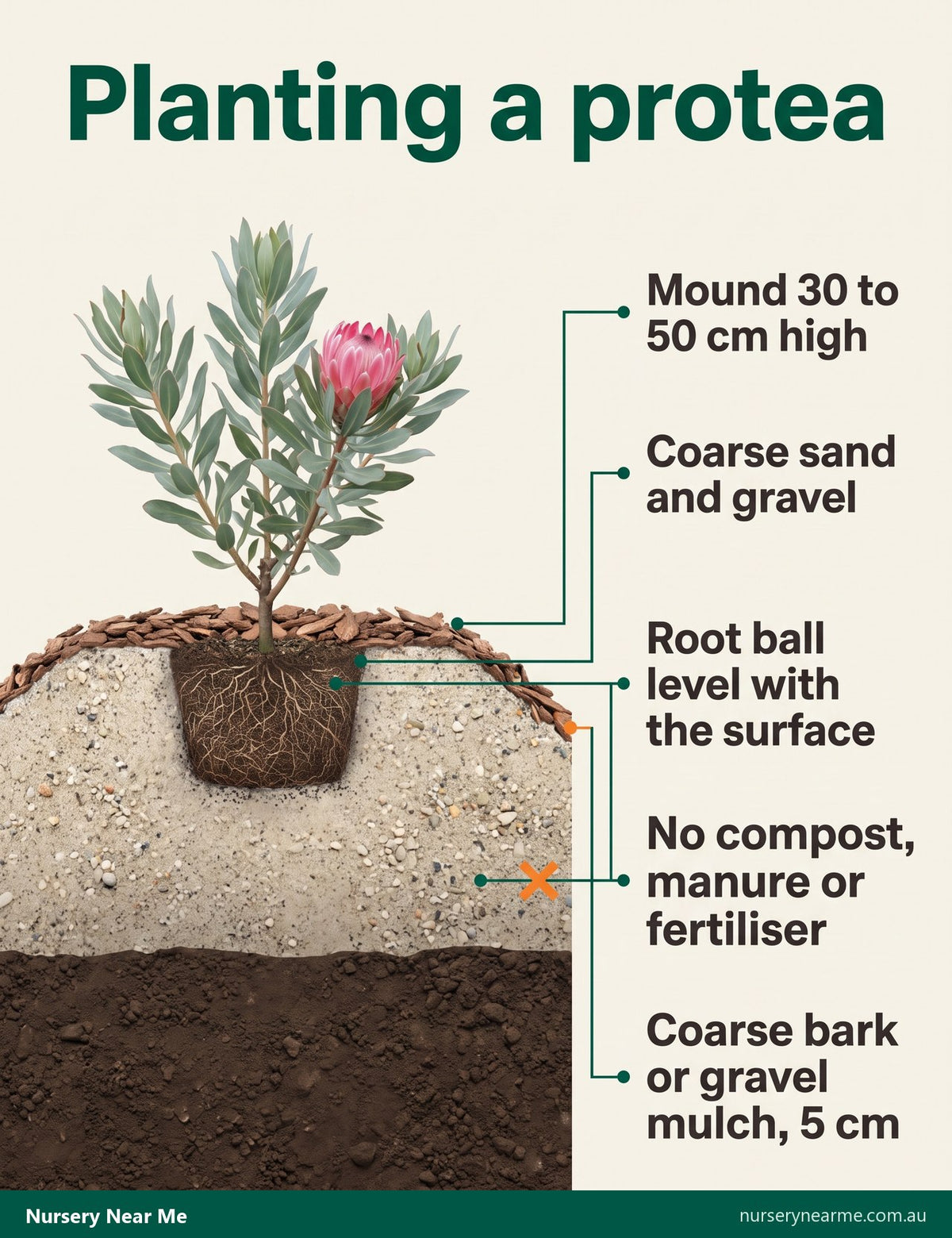
Drainage. This is the first and most important requirement. Proteas die of root rot in soil that stays wet, especially warm, wet soil in summer. Sand, sandy loam, gravelly soil and decomposed granite suit them. On heavier ground, plant on a mound or raised bed 30 to 50 cm high built from coarse sand and gravel, or on a slope. If water sits in a test hole for more than an hour or two, choose another site. Our guide to fixing poor drainage explains the options.
Acidity. Proteas need an acid soil, ideally pH 5 to 6. On alkaline or limy soil they yellow and decline. Never add lime, and keep them away from fresh concrete footings and paths, which leach lime.
An open, sunny, airy position. Give them at least six hours of sun and space around each plant. Still, shaded, crowded spots hold humidity on the leaves and invite disease. A site that catches the breeze is ideal, and most are wind tolerant once their roots are established.
Planting. Plant in autumn where winters are mild, so the roots establish in cool, moist soil, or in spring in frosty districts. Dig a hole no deeper than the pot. Do not add compost, manure or fertiliser of any kind. Slide the plant out without disturbing the roots: do not tease, cut or loosen them. Set the root ball level with or very slightly above the surrounding soil, backfill with the same soil, and water in. Stake only if the site is very exposed, and loosely.
Mulch. Mulch with coarse bark, wood chips or gravel, 5 cm deep, kept back from the stem. Do not use manure, mushroom compost or pea straw, which are too rich. Proteas have a mat of fine feeder roots just under the surface, so never dig or hoe around them: pull weeds by hand.
Watering and feeding
Watering. Water a new plant deeply once or twice a week through its first two summers. After that, most proteas in the ground need only a deep soak every week or two in prolonged dry weather. Water the soil, not the foliage, and water in the morning. Plants in pots need watering all year and must never dry out completely.
Feeding: the phosphorus rule. Proteas evolved on some of the poorest soils on Earth and grow dense clusters of fine roots that strip every trace of phosphorus from the ground. Given ordinary fertiliser they take up far too much, and it poisons them: leaves blacken and die back from the tips, and the plant can collapse. In most garden soils proteas need no fertiliser at all. If growth is weak on very poor sand, use a fertiliser made for native plants with a phosphorus figure of 2 per cent or less, at half strength, once in spring. Keep lawn fertiliser, chicken manure pellets and general garden fertilisers well away from them. The same rule applies to Australian relatives, as explained in our grevillea care guide.
In a pot. A pot is the way to grow proteas on clay soils and in humid districts, because you control the drainage and can keep the plant under cover in wet weather. Little Prince, the pincushions and young Pink Ice all grow well in containers. Use a pot at least 40 cm wide with large drainage holes, raised on feet, and a potting mix made for native plants, which is low in phosphorus. Stand it in full sun with good air movement. Water when the top few centimetres are dry, feed sparingly with a low-phosphorus native fertiliser in spring, and repot into fresh mix every two to three years, handling the roots as little as possible.
Pruning and cutting flowers

Picking the flowers is the pruning. Proteas and pincushions that are cut regularly stay compact and flower more heavily, while those left alone become tall, woody and sparse.
The rule for most proteas and pincushions. Cut each flowered stem with a long stalk, leaving 10 to 15 cm of healthy, leafy stem on the bush. New shoots break from the buds among those leaves and carry the following season's flowers. Never cut back into bare, leafless wood: on Pink Ice, White Ice and most pincushions, bare wood does not reshoot and the branch dies.
The exceptions. The king protea, Little Prince and the pincushion Goldie grow from a woody base called a lignotuber and can reshoot from low down. An old, straggly king protea can be cut back hard after flowering and will regrow.
Young plants. Tip-prune in the first two years, pinching out the soft shoot tips in spring, to build a bushy, well-branched plant before it is allowed to flower heavily.
Common problems and fixes
Sudden wilting and death. Root rot from poor drainage or overwatering in warm weather. It cannot be cured. Replant on a mound or in a pot, in a different place.
Leaves blackening from the tips, or red and yellow mottling. Phosphorus toxicity from fertiliser, manure or enriched potting mix. Stop feeding and water deeply to flush the soil.
Yellow new leaves with green veins. The soil is too alkaline and the plant cannot take up iron. Apply iron chelate and check for lime sources nearby.
Brown spots and blotches on leaves. Fungal leaf disease in humid, still conditions. Improve air movement, water only at the base, and remove badly affected leaves.
No flowers. Too much shade, a plant that is still too young, or frost damage to the buds. King proteas in particular can take three or four years to flower.
A tall, bare, woody bush. Not enough cutting. Start picking with long stems each year, but do not cut into leafless wood.
Frequently asked questions
Are proteas easy to grow in Australia?
In southern Australia, on free-draining acid soil in full sun, they are very easy and need almost no care. In heavy clay or humid subtropical conditions they are difficult and best grown in pots.
Can proteas grow in Queensland?
They are hard to keep in the humid heat of the coast. They do better on the cooler, drier ranges such as the Granite Belt and Toowoomba, in raised beds, or in pots kept out of summer rain.
What fertiliser do proteas need?
Usually none. If you feed at all, use a native plant fertiliser with very low phosphorus at half strength once in spring. Ordinary fertiliser can kill them.
When do proteas flower?
Pink Ice and White Ice flower from autumn through winter into spring. King proteas flower at various times, mainly in the cooler months. Pincushions flower from late winter to early summer.
How long do protea plants live?
A well-sited protea commonly lives ten to fifteen years or more. Regular picking and pruning keeps it productive for longer.
Ready to plant?
Choose from the protea and pincushion collection, and add foliage and winter colour from the leucadendron range. Australian relatives that share the same conditions are in banksias and grevilleas. For more shrubs that prosper on lean, dry ground, read our guides to plants that thrive in poor soil and the best native shrubs for dry gardens. Every plant is sourced from partner nurseries around Australia and delivered Australia wide.
Sources
Growing proteas and the Proteaceae family: Department of Primary Industries and Regional Development, Western Australia. Phosphorus sensitivity in the family: Australian National Botanic Gardens.


