

Peonies are the flowers people fall in love with at a florist and then discover they cannot buy for most of the year. The huge, silky, scented blooms last only a few weeks in late spring, and the plants that produce them are particular about one thing above all: cold. A peony needs a proper winter to flower. Where it gets one, it is among the longest-lived and least demanding plants in the garden, flowering for fifty years or more with almost no attention. Where it does not, it grows leaves and nothing else. So the first question for any Australian gardener is not how to grow peonies, but whether your climate will let you. This guide answers that honestly, then covers planting, care and the herbaceous and Itoh peonies we sell.
Quick facts
| Feature | Detail |
|---|---|
| Plant type | Long-lived perennial that dies back in winter and reshoots in spring |
| Size | About 80 cm to 1 m tall and wide |
| Flowers | Late October to December, for three to four weeks |
| Climate | Cold-winter districts only; will not flower in the subtropics or tropics |
| Position | Full sun; light afternoon shade where summers are hot |
| Soil | Deep, fertile, well drained, neutral to slightly alkaline |
| Planting depth | Shallow: the buds no more than 3 to 5 cm below the surface |
| Time to flower well | Two to three years after planting |
| Lifespan | Decades, if left undisturbed |
Will peonies grow where you live?
Peonies form next spring's flower buds on the crown in autumn, and those buds will not develop unless the plant spends winter properly cold. As a guide, a district that has regular frosts and where apples, cherries and tulips do well will grow peonies.
Reliable districts. Tasmania, the Victorian highlands and much of southern and central Victoria, the ACT, the tablelands of New South Wales including the Blue Mountains, Southern Highlands, Central West and New England, the Adelaide Hills and the cooler inland south of Western Australia. Commercial cut-flower peonies are grown in exactly these areas.
Marginal districts. Melbourne suburbs grow peonies well in most years. In Adelaide, Perth and the warmer inland, results depend on the winter and the position: choose the coldest spot in the garden, one that is open to winter frost and not against a warm wall, and expect lighter flowering after a mild winter.
Unsuitable districts. Coastal Sydney is too mild for dependable flowering, and peonies are not worth planting from the north coast of New South Wales through Queensland, or anywhere in the subtropics and tropics. The plants may survive for a time but they do not bloom, and they decline in humid summers. If you garden in a warm climate and want the same generous flower, consider camellias or gardenias from our camellia collection and gardenia collection instead.
Herbaceous and Itoh peonies

We sell two kinds. Both die back to the ground in winter. The whole range is in the peony collection.
Herbaceous peonies are the classic garden and florist peony, with soft stems that rise from the crown each spring. Coral Charm is one of the most admired of all: large, semi-double, bowl-shaped flowers that open a deep coral and fade through peach to cream as they age, so one plant carries several shades at once. It flowers early in the peony season on tall, strong stems.
Itoh peonies, also called intersectional peonies, are hybrids between herbaceous peonies and tree peonies. They combine the best of both parents: the large flowers and colour range of a tree peony, including the yellows that herbaceous peonies lack, on a plant that dies down in winter like a herbaceous one. Their stems are short and woody at the base and strong enough to hold the flowers up without staking, the foliage is handsome and deeply cut, and a mature plant opens its buds in succession over three or four weeks. They are regarded as slightly more tolerant of mild winters and summer heat than herbaceous peonies, though they still need a cold season.
The Itoh peonies we sell are:
Bartzella. Bartzella is the most famous Itoh, with very large, double, lemon-yellow flowers with a small red flare at the centre and a light, spicy scent.
Cora Louise. Cora Louise has white flowers flushed with lavender, each petal marked at the base with a deep purple flare.
Garden Treasure. Garden Treasure has golden-yellow, semi-double flowers with red flares, on a broad, vigorous plant.
First Arrival. First Arrival opens lavender-pink and softens as it ages, and is among the first Itohs to flower.
Planting

Choose the spot for the long term. Peonies resent being moved and can take two years to recover if they are. Pick a permanent position with at least six hours of sun, good air movement, and no competition from tree roots. In hot inland districts, shade from the mid-afternoon sun makes the flowers last longer.
Soil. They want deep, fertile soil that drains well, and they prefer it neutral to slightly alkaline, around pH 6.5 to 7.5. On acid soil, work in a handful of garden lime or dolomite a few weeks before planting. Dig the bed 40 cm deep and wide and mix in compost and well-rotted manure, keeping fresh manure away from the crown. Peonies rot in soil that stays wet through winter, so raise the bed on clay. See our guide to soil types and how to improve them.
Depth is the rule that matters most. A peony planted too deep grows healthy leaves for years and never flowers. The pink or red buds on the crown, called eyes, must sit no more than 3 to 5 cm below the soil surface in cold districts and only 2 to 3 cm below in milder ones, where shallow planting exposes the crown to as much winter cold as possible. A potted peony should be planted with the top of its root ball level with the soil surface, never deeper.
Spacing and mulch. Space plants about 1 m apart. Mulch around the plant to keep summer moisture in, but do not pile mulch over the crown: it has the same effect as planting too deep.
In pots. Peonies can be grown in a large pot, at least 40 to 50 cm wide and deep, in a premium potting mix. The Itoh kinds suit this best. A pot makes it possible to stand the plant in the coldest, most exposed part of the garden for winter.
Care through the year
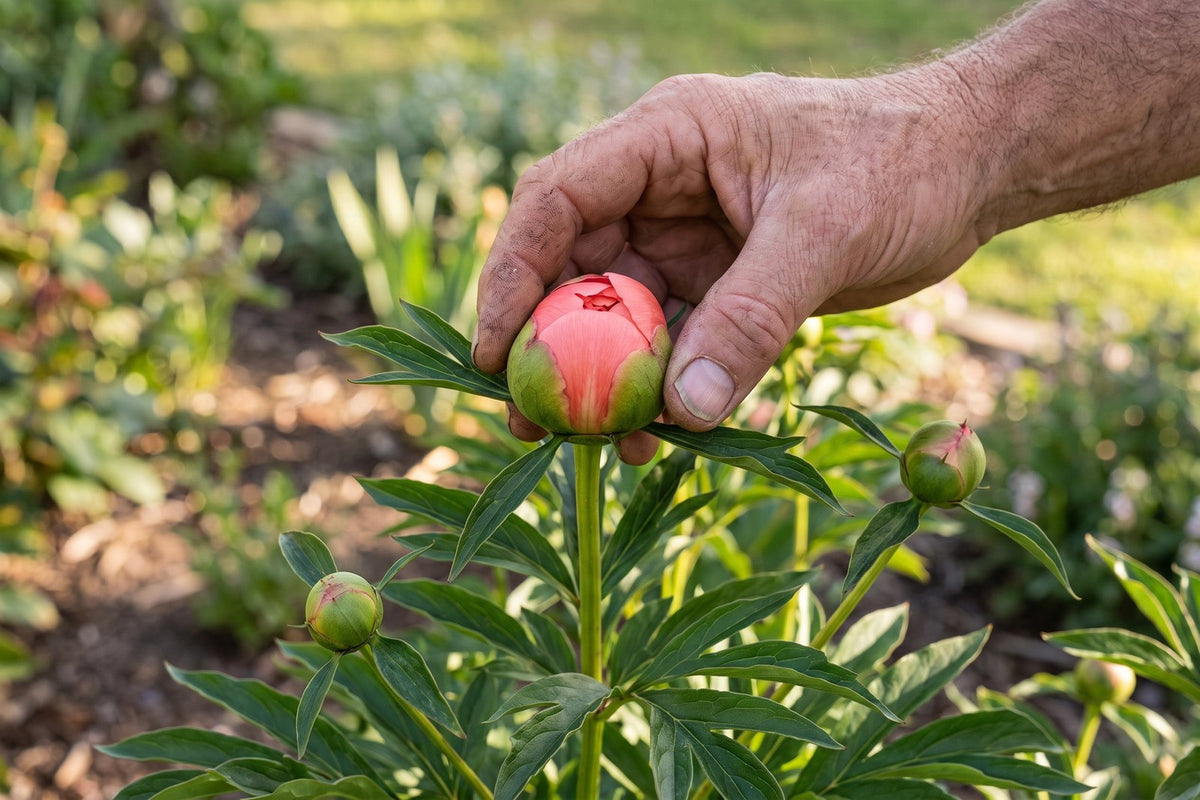
Late winter and spring. Red shoots push through in late winter or early spring. Feed as they emerge with a balanced fertiliser that is not high in nitrogen, scattered around the plant and not on the crown. Too much nitrogen gives leaf and no flower. Keep the soil moist as the buds swell. Tall double herbaceous peonies with heavy flowers benefit from a support ring put in place early: Itohs and Coral Charm generally stand up without one.
Flowering. Ants crawling over the buds are harmless. They feed on the sweet nectar the buds exude and do not damage the flower. To cut for the vase, pick when the bud is showing colour and feels soft like a marshmallow when squeezed gently, and it will open indoors. Leave at least two sets of leaves on each cut stem, and on a young plant take only a few stems so the plant can build strength.
Summer. Remove spent flowers. Keep the foliage healthy and watered through summer: a deep watering once a week in dry weather is enough. The leaves are feeding the crown and forming next year's buds, so do not cut them back early.
Autumn. Feed lightly after flowering and again in early autumn. When the foliage has yellowed and collapsed, cut herbaceous peonies to ground level. Cut Itoh peonies to about 5 to 10 cm, leaving the short woody stubs and any buds on them. Put all the old stems and leaves in the bin, not the compost, to remove disease spores.
Winter. Leave the crown exposed to the cold. Do not mulch over it or cover it.
Patience. A newly planted peony often gives one or two flowers, or none, in its first spring. That is normal. Expect a good display from the third year and an increasing one for decades after. For companions that share the same cold-climate conditions, see our hellebore care guide.
Common problems and fixes
Leaves but no flowers. In order of likelihood: planted too deep, a winter that was not cold enough, too much shade, too much nitrogen, or a plant that is still young or was recently moved. Check the depth first and scrape soil or mulch away from the crown.
Buds that form, turn brown and fail to open. Peony blight, a grey mould disease that is worst in cool, wet springs. Remove affected buds and stems, improve air movement, water at the base, and clear every scrap of old foliage in autumn.
Dark blotches on leaves in late summer. Leaf blotch, usually cosmetic at that time of year. Clean up thoroughly in autumn.
Flowers lying on the ground. Heavy double flowers filled with rain. Fit a support ring in early spring next year, or choose Itoh varieties.
The plant collapses in summer. Root or crown rot from waterlogged soil. Improve the drainage or raise the bed.
A pet that chews the plant. Peonies are listed as mildly toxic to dogs, cats and horses and can cause vomiting if eaten in quantity.
Frequently asked questions
Can peonies grow in Australia?
Yes, in districts with cold winters: Tasmania, most of Victoria, the ACT, the New South Wales tablelands, the Adelaide Hills and cooler parts of southern Western Australia. They do not flower in the subtropics or tropics.
Can I grow peonies in Sydney or Brisbane?
Coastal Sydney is too mild for reliable flowering, although the Blue Mountains and Southern Highlands nearby are excellent. Brisbane and the rest of the subtropics are too warm, and peonies are not recommended there.
Why is my peony not flowering?
The most common reason is planting too deep. The buds on the crown should be no more than 3 to 5 cm below the surface. A mild winter, shade, heavy nitrogen feeding or a young plant are the other causes.
What is an Itoh peony?
A hybrid between a herbaceous peony and a tree peony. It dies back in winter like a herbaceous peony but has strong stems that need no staking, a longer flowering period and colours such as yellow.
How long do peonies take to flower?
A potted plant may flower lightly in its first or second spring and should flower well from the third. Once established, peonies flower every year for decades.
Ready to plant?
Choose from the peony collection, and build a cold-climate border around them from our plants for cool climates and hydrangeas. For planting partners, read our guides to perennial plants for a cottage garden and frost tolerant plants in Australia. Every plant is sourced from partner nurseries around Australia and delivered Australia wide.
Sources
Cool-climate gardens where peonies are grown: Royal Botanic Gardens Victoria. Plants and pets: ASPCA Animal Poison Control plant list.


