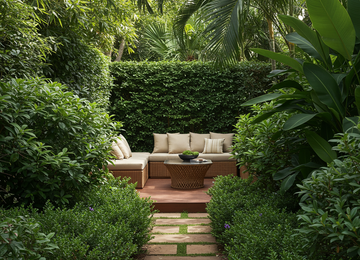
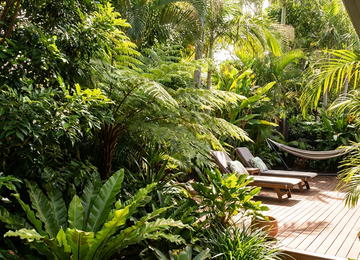

Pools concentrate every landscaping mistake: invasive roots meet plumbing, leaf drop meets filtration, spiky meets bare feet. The safe list isn't long, but it's more than enough to build a resort, here's how professionals choose.
The three tests
Roots: fibrous and contained, never water-seeking. Litter: foliage that holds on rather than sheds seasonally, and no berries or small flowers over water. Contact: nothing spiky or sappy beside wet skin. Every plant below passes all three.
The safe all-stars
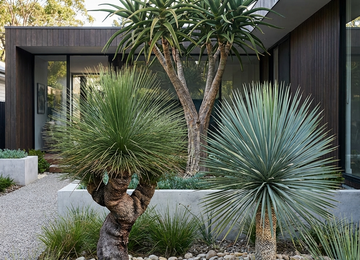
Golden Cane Palm: the definitive pool palm: contained fibrous roots, fronds that stay attached until pruned. Slender Weavers Bamboo: strictly clumping, vertical, and the standard pool-fence screen. Philodendron Xanadu: lush mounds, zero drop. Spineless Yucca: the architectural one, specifically the spineless species. Poa tussocks and Cousin It: soft edges that cope with splash and salt systems alike.
The never list
Ficus of any kind (roots that hunt moisture through hairline cracks), willows and poplars (same crime, faster), jacaranda and liquidambar (the filter-clogging leaf load), bougainvillea against walkways (thorns), and anything that rains berries. If a tree is deciduous and within ten metres of the water, you will meet its leaves personally, weekly, all autumn.
Keep distance anyway
Even safe plants belong a metre back from coping, for maintenance access and to keep mulch out of the skimmer. Raised planters solve both elegantly and give Cousin It something to spill over.
The ready-made surround
The pack below dresses a standard family pool: bamboo behind the fence line, golden canes for canopy, xanadu and tussocks at the edges, yuccas as sculpture. It's the plant half of our full poolside structure garden; resize anything in the garden pricer.
Still at the planning stage? Swimming Pool Kits Direct has a pool cost calculator that gives a rough figure for the pool itself before you budget for the planting around it.
