

Every house has one: the strip down the side, 1 to 2 m wide, home to the hose reel and a view of the neighbour's colorbond. It's also, secretly, the easiest transformation on the whole block, because a narrow space only needs a narrow idea, done confidently, repeated.
The idea
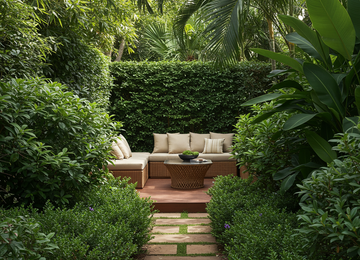
Corridors want rhythm, not variety: one vertical screen along the fence, one climber softening the house wall, one carpet underfoot. The eye reads repetition as length and greenery as width, a planted corridor genuinely feels wider than a bare one, because the boundaries stop reading as walls.
The palette
The screen: Slender Weavers Bamboo. The narrowest tall screen in horticulture, six metres of privacy from a 40 cm footprint, strictly clumping, evergreen, and faster than anything else that fits. Six plants screen a typical side run; adjust in the pack below.
The alternative texture: Pittosporum Silver Sheen. Where the strip gets morning sun, alternate bamboo runs with clipped silver-green panels, the two-texture rhythm is what elevates the corridor from screened to designed.
The house wall: Star Jasmine on wires. The blank brick or fibro side of the house becomes a flat green tapestry with white spring perfume, in a footprint of ten centimetres.
The floor: Mondo Grass between steppers, Cousin It along edges. Fifty mondo sounds extravagant until you see a continuous green seam running the length of the house.
How to plant it
Bamboo goes against the fence at one plant per metre, jasmine wires at 30 cm spacings on the wall, steppers down the middle, mondo in every gap. Side strips are usually rain-shadowed by the eaves, run a cheap dripline the length of the bed and the corridor thrives on a tap timer.
Good to know
Shadier than an hour of sun? Swap pittosporum for the shade retreat ferns. Wider than two metres? You've got room for the layered privacy approach instead. More slimline options in bamboo and climbers & groundcovers: or price your corridor in the garden pricer.
Ready to make it real? Your instant garden pack is just below: every plant in this design, live-priced from today's stock, one click to add the lot to your cart or open in the garden pricer and make it yours.
