
Tropical Plants
Live plants delivered Australia wide. 30 day healthy plant guarantee.

Tropical plants trade on scale: big glossy leaves, bold flowers and fast lush growth that turns a bare corner into a resort bed in a couple of seasons. This range holds over 400 of them, from foxtail palms and giant bird of paradise down to xanadu philodendrons, cordylines and heliconias. Winter is the deciding factor, because most are frost tender, so the real choice is between planting out, potting up or growing indoors. Filter by height, position and climate below.
Which size? How many?
Size ladder: what each pot looks like on arrivalHedge calculator: plants per metre, pricedHeights on arrival sit under every size on the product page. Freight is quoted with multiple freight companies and passed on at cost.

Senegal Date Palm Phoenix reclinata
7 sizes, 300mm to 2500L
42% offFrom $148.95$256.95Unit price /Unavailable-
Split Leaf Cyclanthus Cyclanthus bipartitus
3 sizes, 140mm to 400mm
45% offFrom $38.82$70.65per plant, packs of 6Unit price /Unavailable -
Silver Star Palm Cryosophila warscewiczii
2 sizes, 300mm to 400mm
19% offFrom $264.95$327.95Unit price /Unavailable -
Machado Palm Borassodendron machadonis
4 sizes, 300mm to 110L
23% offFrom $198.95$258.95Unit price /Unavailable -
Narrow Lobed Philodendron Philodendron stenolobum
2 sizes, 300mm to 400mm
53% offFrom $115.95$248.95Unit price /Unavailable 
Imperial Green Philodendron Philodendron 'Imperial Green'
5 sizes, 140mm to 500mm
22% offFrom $82.95$105.95Unit price /Unavailable-
Finger Leaf Philodendron Philodendron goeldii
2 sizes, 180mm to 300mm
11% offFrom $87.15$97.99per plant, packs of 6Unit price /Unavailable -
Unicorn Pandanus Pandanus unicornutus
3 sizes, 285L to 1000L
46% offFrom $16,500.95$30,377.95Unit price /Unavailable -
Queensland Black Palm Normanbya normanbyi
3 sizes, 400mm to 600L
47% offFrom $8,250.95$15,567.95Unit price /Unavailable -
Rigid Fan Palm Livistona rigida
42% off$1,464.95$2,525.95On backorderUnit price /Unavailable -
Sallehana Fan Palm Licuala sallehana
2 sizes, 300mm to 400mm
48% offFrom $924.95$1,778.95Unit price /Unavailable -
Orbicular Fan Palm Licuala orbicularis
36% off$627.98$981.31per plant, packs of 3On backorderUnit price /Unavailable -
Rusty Fan Palm Licuala ferruginea
49% off$232.98$456.98per plant, packs of 3On backorderUnit price /Unavailable -
White Elephant Palm Kerriodoxa elegans
33% off$1,594.95$2,380.95On backorderUnit price /Unavailable -
Oliviform Palm Kentiopsis oliviformis
3 sizes, 300mm to 110L
18% offFrom $264.95$323.95Unit price /Unavailable -
18% off$200.95
$245.95On backorderUnit price /Unavailable -
Whitelock's Cycad Encephalartos whitelockii
2 sizes, 45L to 90L
47% offFrom $1,980.95$3,737.95Unit price /Unavailable -
Tongaland Cycad Encephalartos ferox
39% off$2,929.95$4,803.95On backorderUnit price /Unavailable -
2 sizes, 300mm to 400mm
48% offFrom $157.95$303.95On backorderUnit price /Unavailable -
Triple Crown Palm Dypsis prestoniana
5 sizes, 300mm to 600L
42% offFrom $594.95$1,025.95Unit price /Unavailable -
3 sizes, 400mm to 90L
44% offFrom $401.95$717.95On backorderUnit price /Unavailable -
Madagascar Cane Palm Dypsis madagascariensis
2 sizes, 160L to 350L
23% offFrom $2,062.95$2,679.95Unit price /Unavailable -
Redneck Palm Dypsis lastelliana
3 sizes, 300mm to 160L
13% offFrom $181.95$209.95Unit price /Unavailable -
Ampasindavae Palm Dypsis ampasindavae
2 sizes, 300mm to 400mm
17% offFrom $198.95$239.95Unit price /Unavailable -
41% off$990.95
$1,679.95Unit price /Unavailable -
Hooperiana Palm Chamaedorea hooperiana
2 sizes, 300mm to 400mm
28% offFrom $429.95$597.95Unit price /Unavailable -
Carpoxylon Palm Carpoxylon macrospermum
2 sizes, 400mm to 75L
21% offFrom $330.95$418.95On backorderUnit price /Unavailable -
3 sizes, 400mm to 700mm
41% offFrom $579.95$983.95On backorderUnit price /Unavailable -
Darcyi Shampoo Ginger Zingiber zerumbet 'Darcyi'
45% off$176.98$321.98per plant, packs of 3On backorderUnit price /Unavailable -
Calappa Palm Actinorhytis calapparia
49% off$723.95$1,419.95On backorderUnit price /Unavailable -
4 sizes, 200mm to 500L
24% offFrom $43.65$57.49per plant, packs of 6Unit price /Unavailable -
Pink Bicajoux Calathea Calathea 'Bicajoux Pink'
20% off$55.99$69.99per plant, packs of 6On backorderUnit price /Unavailable


More information
Building a tropical garden in layers
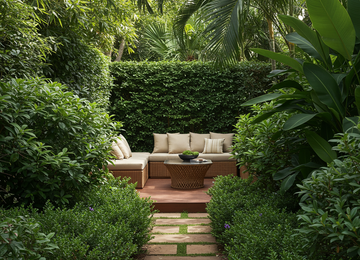
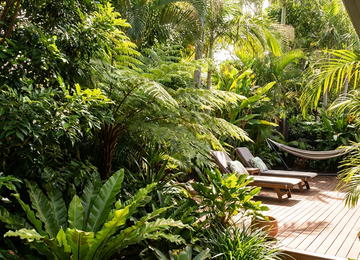
The lush look is really a planting formula: canopy, mid storey, understorey. For the canopy, the Foxtail Palm (Wodyetia bifurcata) is the fast growing headline act at around 10m, with the slower kentia a refined choice for shade and pots. The mid layer carries the drama: Giant White Bird of Paradise reaches about 6m with paddle leaves, and heliconias such as 'Hot Rio Nights' hold hanging red bracts at 3m. Underneath, xanadu philodendron mounds to 1m, cordylines and crotons add leaf colour at 1.5m to 2m, and elephants ear fills shade with 1.8m of glossy green. The palm range and heliconia range go deeper on the two signature families.
Where tropical plants grow in Australia
In Cairns, Darwin and Brisbane, everything here grows outdoors and the only limits are space and drainage. Warm temperate gardens in Sydney and Perth can still run a convincing tropical scheme by choosing from the large group tagged for their zone: strelitzias, golden cane palms, frangipani and most cordylines cope, especially against a warm wall or by a pool. In Melbourne, Canberra and the frosty inland, treat the true tropicals as pot plants that summer outside and winter under cover, or grow the indoor half of this range as houseplants. Our tropical climate collection filters the range to the plants happiest in the far north.
Planting and spacing for the lush effect
Tropical beds are planted tighter than ordinary borders because overlap is the point. Space giant bird of paradise 2m apart for a screen, golden cane palms 1.5m, heliconias 1.5m, and elephants ear and xanadu 1m for solid understorey cover. Shelter matters as much as spacing: the big paddle leaves shred in wind, so plant them behind a fence, wall or windbreak. Give everything deep, rich soil with compost dug through, and shade the understorey plants from harsh afternoon sun.
Water, feeding and the winter question
These plants grow hard in the warm months and want steady moisture and food to do it: mulch deeply, water thoroughly in dry spells, and feed monthly with a liquid or twice a season with controlled release fertiliser from spring to early autumn. Then ease off. Cold wet soil in winter does more damage than cold air, so let pots dry further between drinks and hold the feed until spring. Poolside planting deserves its own thought, and our tropical poolside plant guide covers the tidy, non invasive choices.
Common questions
Can I grow tropical plants in Melbourne?
Outdoors, only the hardiest few in sheltered warm microclimates. The reliable route is pots that move under cover before frost, or the indoor tropicals: monstera, philodendrons, peace lilies and kentia palms all thrive inside a Melbourne living room.
Which tropical plants work around a pool?
Foxtail palms, giant bird of paradise, xanadu, cordylines and evergreen frangipani are the standards. Palms are particularly good value here because their fibrous roots will not lift paving.
Are tropical plants safe for pets?
Assume not unless the product page carries our Pet Friendly flag. Alocasias, philodendrons and monstera all contain irritant calcium oxalate, while golden cane and kentia palms are flagged pet friendly and make the safer choices for a garden with animals.
How fast will a tropical garden fill in?
Faster than any other style in a warm climate. Planted in spring at the spacings above, heliconias, elephants ear and strelitzias give a full layered look by the second summer, with palms adding height each year after.
