

Bamboo gives height and privacy faster than almost any other plant, in a strip of ground barely a metre wide. The catch is choosing the right type. This guide covers clumping versus running bamboo, where it performs across Australia, and the care that keeps a screen dense.
Clumping only, and it is not negotiable
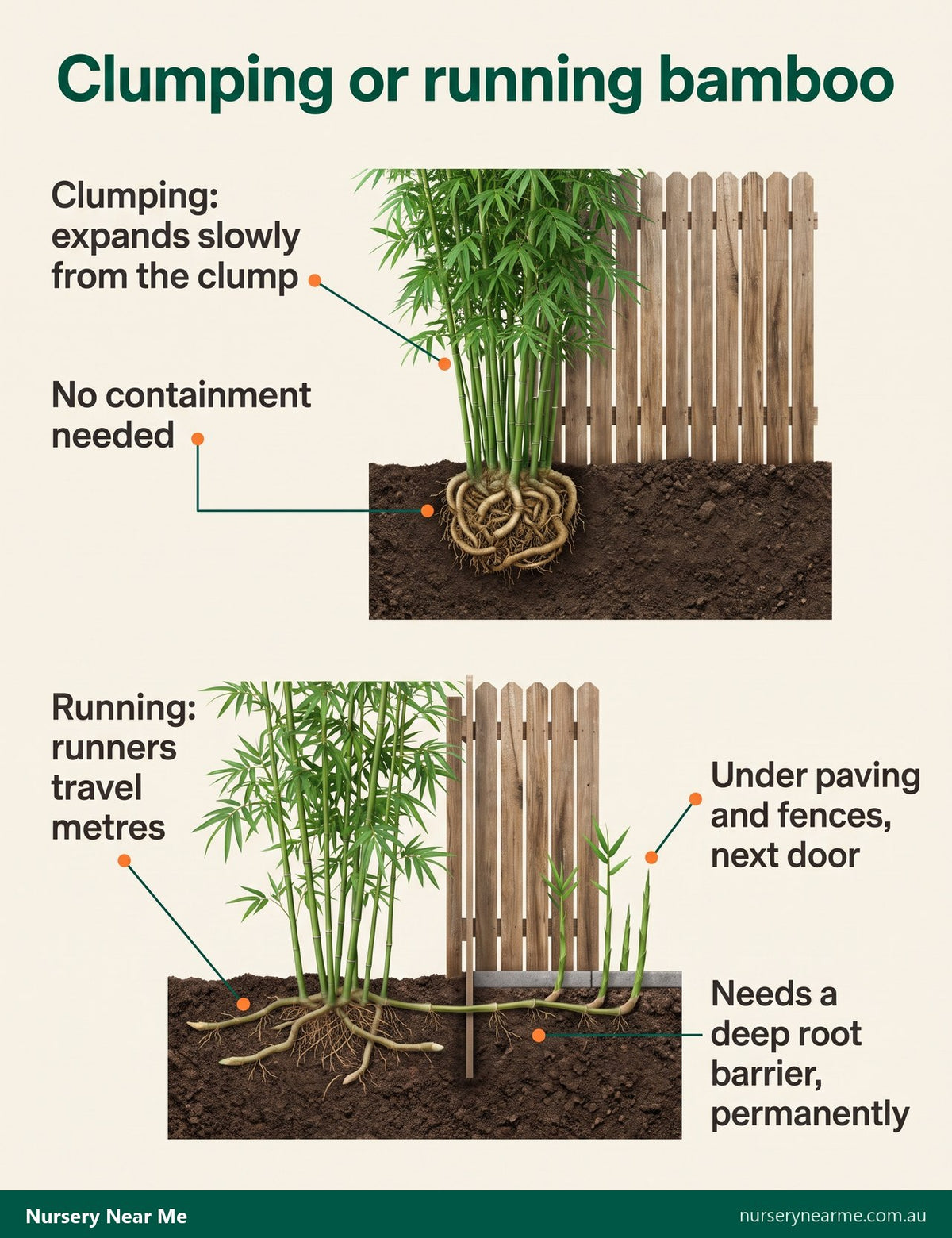
Before anything else about bamboo, this needs settling. There are two types and only one belongs in an Australian garden.
| Clumping | Running | |
|---|---|---|
| Habit | Expands slowly from a defined clump | Sends runners metres in every direction |
| Containment | None needed | Deep root barrier, permanently |
| Genus | Bambusa, Dendrocalamus | Phyllostachys, Pleioblastus |
| Suburban garden | Yes | No |
Running bamboo travels under paving and fences into neighbouring properties, is extremely difficult and expensive to remove once established, and has been the subject of genuine neighbour disputes in Australia. Check the label rather than assuming.
Where bamboo performs in Australia
| Location | How it performs |
|---|---|
| Brisbane, Gold and Sunshine Coasts | Excellent - fast, dense, evergreen year-round |
| Darwin and tropical Queensland | Fastest growth anywhere; needs more thinning |
| Sydney and coastal NSW | Very good with reliable water |
| Perth | Workable with irrigation - sandy soil dries fast |
| Melbourne and Adelaide | Good in sheltered positions; slower in winter |
| Canberra and cold inland | Marginal - hard frost damages culms |
Lucky bamboo is not bamboo
Worth clearing up, since it is the "bamboo" most people have indoors. Dracaena sanderiana is a dracaena, not a bamboo at all. It grows in water or soil in bright indirect light, and it is unusually sensitive to fluoride - which is in most Australian municipal water and shows as brown leaf tips. Use rainwater or filtered water, and change it weekly so it does not breed mosquitoes.
Indoors versus outdoors
True bamboo generally does poorly as a long-term indoor plant in Australia - it wants strong light and airflow, and dry indoor air from air conditioning or heating causes leaf drop. Outdoors it is a different plant entirely.
In a large pot on a patio, smaller species like Goldstripe (Bambusa multiplex) work well at three to four metres. For screening in the ground, Slender Weavers is the Australian standard at six to seven metres in a narrow clump.
Care
- Water consistently. Bamboo is a grass and a thirsty one - a drought-stressed clump thins and drops leaves.
- Feed in spring and midsummer with a high-nitrogen or lawn-type fertiliser. Bamboo responds strongly to nitrogen, unlike Australian natives.
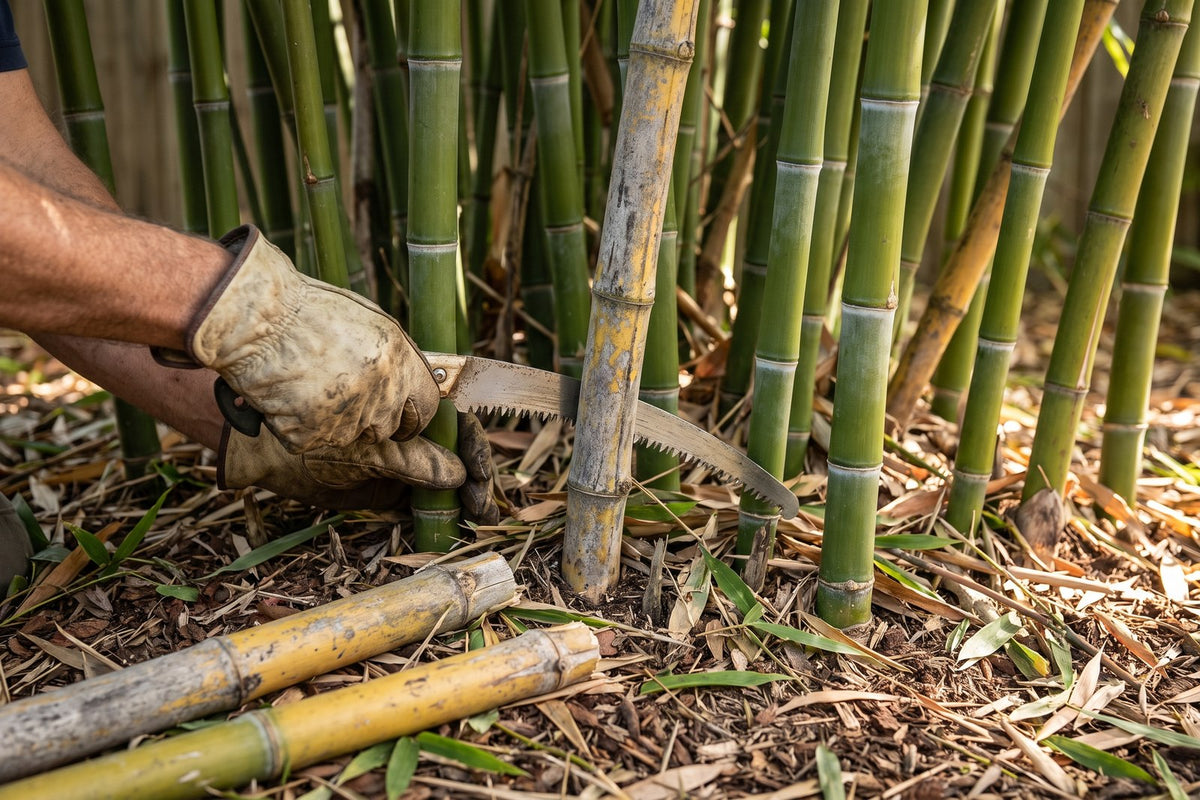
- Thin old culms annually - remove the oldest third at ground level to keep the clump open and show the culms.
- Enrich the soil at planting with compost and manure.
- Expect slow establishment then rapid growth - the first year is modest, and from year two or three new culms emerge at close to full height in a season.
Related guides
Bamboo is at its most useful as a screen, where nothing else gives the same height in the same narrow footprint. For a tall, tight screen the clumping Slender Weavers bamboo is the variety most Australian gardens end up with, because it grows tall while staying under a metre wide at the base.
Our bamboo screening guide covers clumping varieties, spacing and care in full, and our guide to how bamboo enhances garden aesthetics covers the design side.
Around a pool, bamboo has to cope with splash, reflected heat and constant leaf clean-up, which our guide to efficient pool area screening covers in detail.
If your boundary is short, exposed or shaded, our guide to alternative hedging plants covers the species that do the same job in different conditions. The full bamboo range is here.
Ready to plant?
Buy clumping bamboo, never running bamboo, and plant the whole run at once so it fills evenly. Browse our bamboo for screening range to compare mature heights.


